An Overview of the Framework
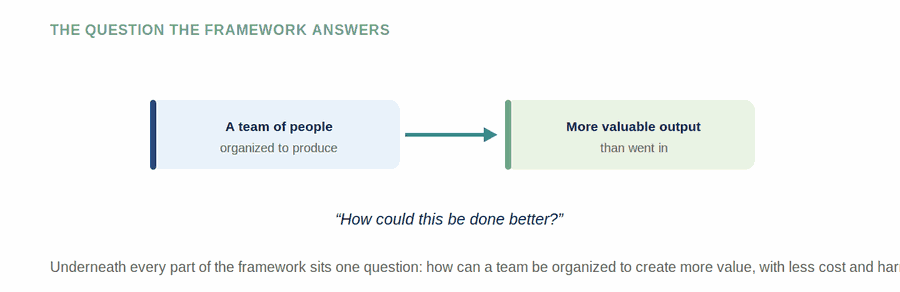
This book describes a way of thinking about teams. Not a set of management tips, and not a leadership philosophy, but a framework: a structured, repeatable way to look at any group of people organized to produce something, and to ask, with discipline, how that group could produce more value with less cost and harm. It is called The Science of Teams, and this short chapter is meant only to orient you before the work begins. It explains the shape of the framework and how its parts fit together. It does not teach the framework; the chapters that follow do that, one piece at a time.
It helps to start with the question the whole framework exists to answer. Take any team, a department, a crew, a committee, a company, and you have a group of people organized to turn something into something more valuable. Raw materials become products. Questions become answers. Data becomes decisions. The framework asks one question of any such team, and asks it rigorously: how could this be done better?
That question sounds simple, and people ask versions of it constantly. What makes this a science rather than an opinion is that the framework gives the question structure. It defines precisely what a team is, what better means, how to measure it, how to find the single change that would help most, and how to keep that change pointed at the larger goals of the organization. Where ordinary problem-solving relies on instinct and experience, this framework supplies a method, one that different people, given the same information and goals, can apply to reach the same conclusions.
How the Parts Fit Together
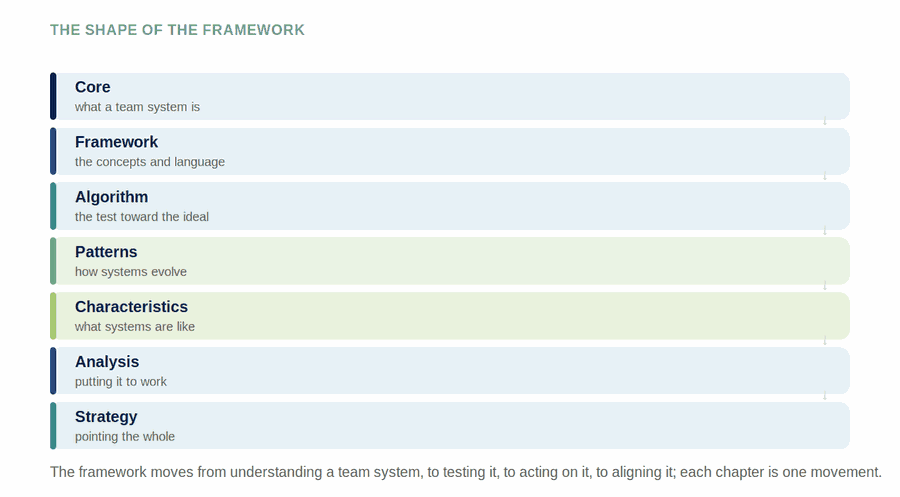
The framework has a natural progression, and the chapters of this book follow it. Think of the progression as moving from seeing, to understanding, to acting, to aligning. You first learn to see a team clearly as a system. You then acquire the concepts and the language to describe it, the algorithm to test it against its ideal, the patterns that describe how it changes over time, and the characteristics that describe what it is like. With those in hand, you learn to put them to work in a full analysis, and finally to point that analysis in the direction the whole organization needs to go.
Each movement has its own chapter, and it is worth knowing in advance what each one contributes, so that as you read you always know where you are in the larger picture.
The core establishes what a team system actually is: people organized to convert inputs into more valuable outputs, and the foundational idea that such a system is ideal not when everything possible has been added to it, but when nothing more can be removed while its value is preserved. The framework chapter then supplies the concepts and the vocabulary the rest of the book depends on: positive innovation, value conflict, the value chain, contradiction, and the fluid sense in which any team is at once a system, a role in something larger, and a home to smaller systems within it.
The algorithm is the formal heart. It defines the ideal final result a team evolves toward, and gives a precise, repeatable test for how close a team sits to that ideal and what specific change would move it closer. Around the algorithm sit two descriptive bodies of knowledge. The patterns describe how team systems evolve through time, how they emerge, advance, transform, and eventually either rise into something larger or pass away. The characteristics describe what team systems are like at any given moment, the qualities such as speed, safety, simplicity, and reliability that any real team trades against one another.
A later chapter deepens the ideal itself, defining in qualitative terms what an ideal system is actually made of, through a set of recurring patterns observed in systems that create and spread value well. Then solution analysis brings everything together into a single working method, and example analysis walks that method through real situations. A catalog of solution models offers a library of concrete moves for resolving the contradictions analysis uncovers. Strategic analysis lifts the view from the single team to the whole enterprise, and a closing note turns to the disruptive thinking that the most valuable ideals demand.
How to Read This Book
You do not need a background in management theory or in any of the sciences the framework borrows from. The chapters are written to be read in order, because each builds on the language and ideas established before it, and a running example threads through most of them so that the abstractions always touch something concrete. The diagrams are not decoration; they are meant to fix the shape of each idea in memory, so that in practice the picture alone is often enough to recall the whole concept.
A reasonable way to read is simply to begin, and to trust that the pieces will connect. By the time you reach the analysis chapters, the early concepts will have become familiar tools rather than new terms, and the framework will have started to feel less like a body of theory to memorize and more like a way of seeing that you can turn on any team, anywhere, including your own. That is the intent of the whole work: not to be studied once, but to change how you look at the organized effort of people from now on.
The Science of Teams: The Complete Framework
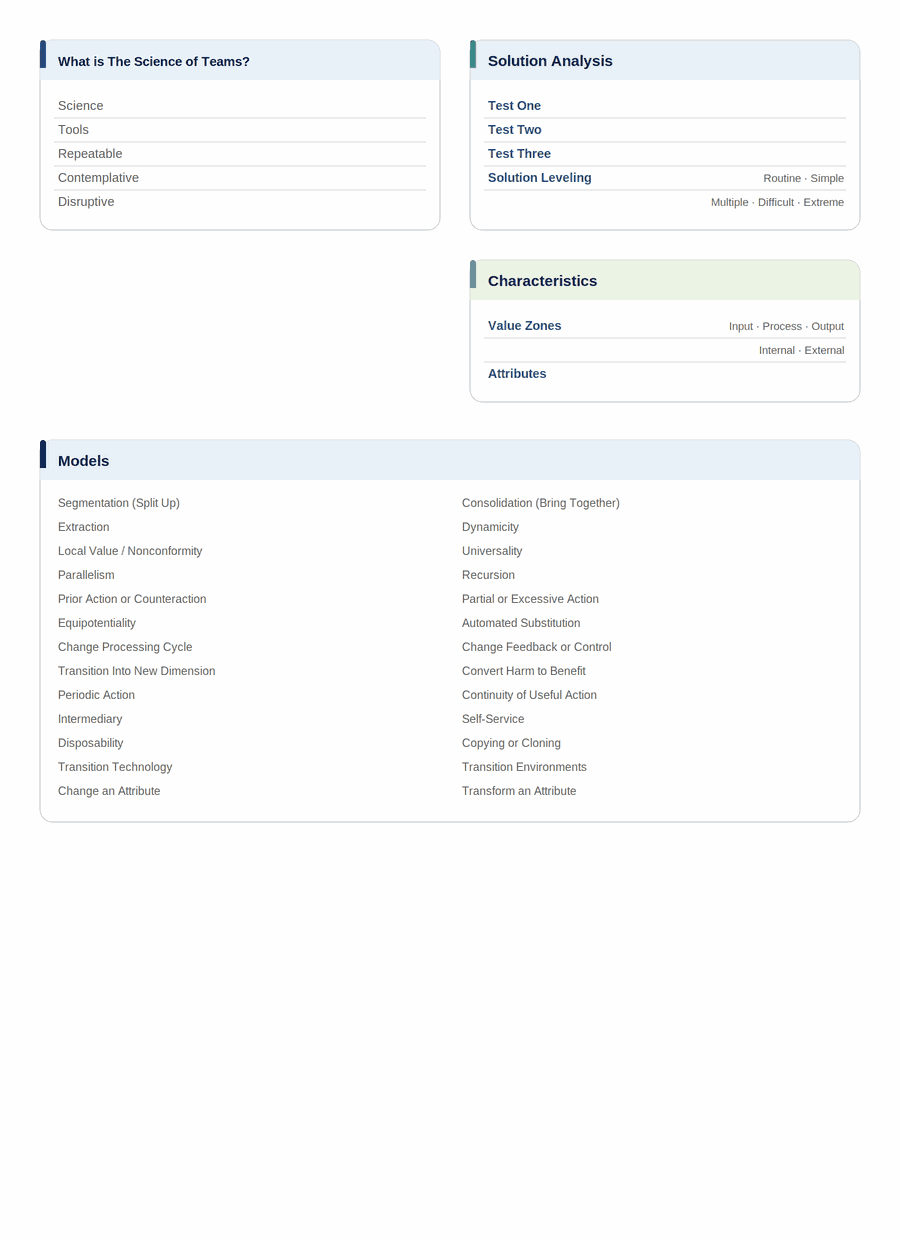
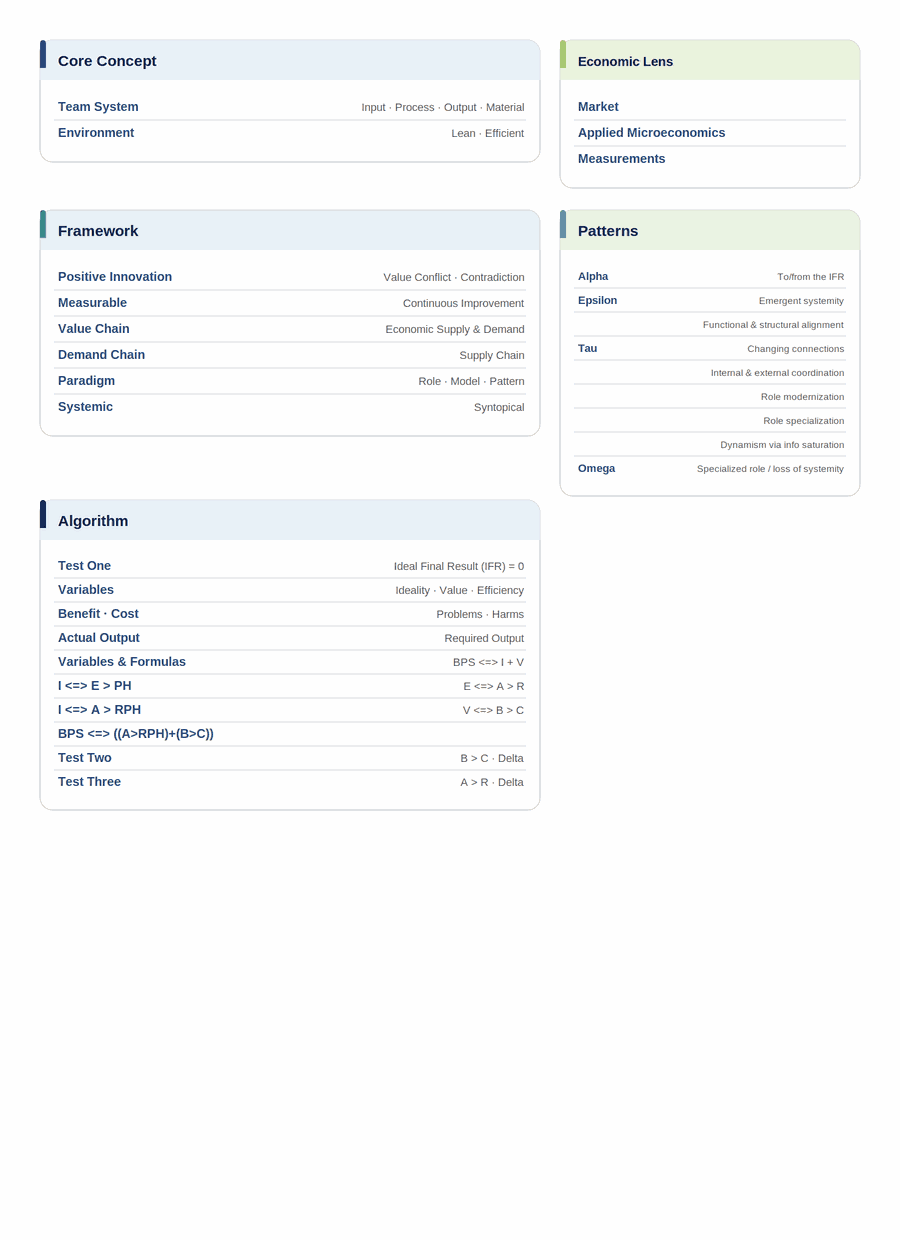
The Science of Teams Core
The Science of Teams (TSoT) is an original scientific framework for analyzing systems of people, or what are frequently called teams, and finding ways to better organize them to improve team output without negatively impacting team efficiencies or increasing a team's costs.
Professionals interested in TSoT include leaders and aspiring leaders at all organizational levels: individual contributors, supervisors, managers, directors, department heads, project managers, human resource professionals, and anyone tasked with producing outputs through people who is seeking a best-practice functional and technical framework.
Learning Objectives
On completing this chapter, the reader will be able to:
- Define a team system and the core terms that compose it: team, input, material, process, and output.
- Explain the foundational principle that team systems exist to produce measurable output that has value.
- Articulate the principle of ideality, that a team system is ideal when nothing more can be removed while output is preserved.
- Distinguish the philosophically lean and philosophically efficient drivers of team-system expansion, and the role of the market.
- Describe the deliberate hard-science scope of TSoT and why soft factors are intentionally excluded.
Defining the Team System
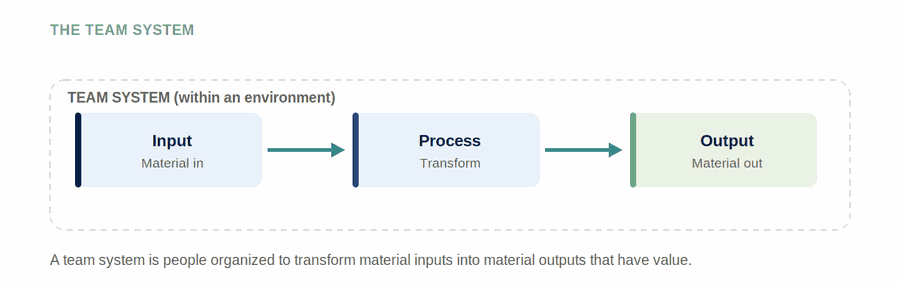
To capture a more precise language construct, TSoT combines the terms systems of people and teams into the single combined term team systems. TSoT is then a framework to evaluate and propose optimal team systems. The framework is built on a small set of carefully defined terms.
- Team: Persons organized into an activity.
- Input: A tangible or intangible, final or intermediary, material.
- Material: Facts, data, information, ideas, or physical matter from which things can be made.
- Process: The action or inaction of transforming material inputs into material outputs.
- Output: A tangible or intangible, final or intermediary, transformed material input.
Output That Has Value
The core of TSoT is designed around the foundational principle that team systems are formed to produce measurable output that has value. As such, TSoT is a strong management tool for organizing teams in administration and industry, because those teams are generally measured in specific ways, including value and output, weighed against the cost or problems of having the team systems exist.
The Principle of Ideality
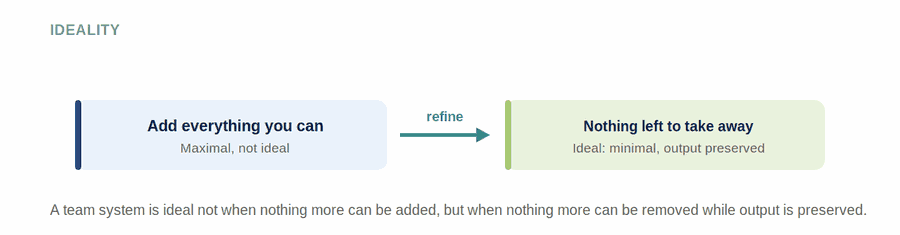
A team system is ideal not when you have put everything you can think of into it to get the output you desire, but when you have nothing left to take away from it while preserving the desired output. Ideality is therefore a discipline of subtraction rather than addition, and it reframes optimization as the search for the smallest sufficient team system rather than the most complete one.
Value Conflict: Lean, Efficient, and the Market
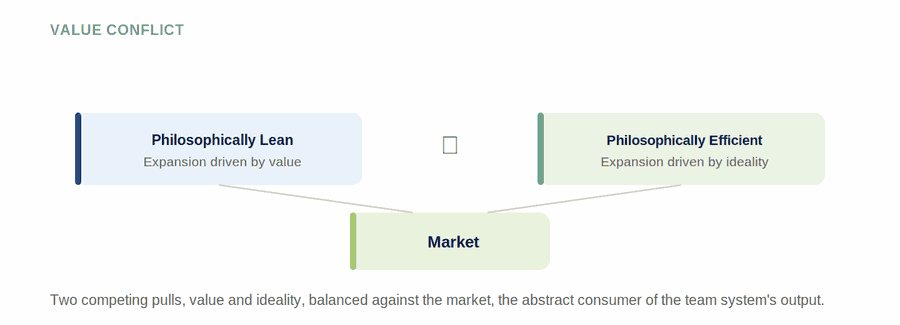
Two philosophies govern how a team system should expand, and they often pull against one another.
- Philosophically Lean: The expansion of a team system depends on the positive measurement of value.
- Philosophically Efficient: The expansion of a team system depends upon the positive measurement of ideality.
- Market: The abstract consumer of team system output.
The lean view expands a team system when doing so adds measurable value; the efficient view expands it only when doing so improves ideality. The two are balanced against the market, the abstract consumer whose valuation of the output is the ultimate arbiter of whether an expansion was justified.
A Hard-Science Framework, Deliberately
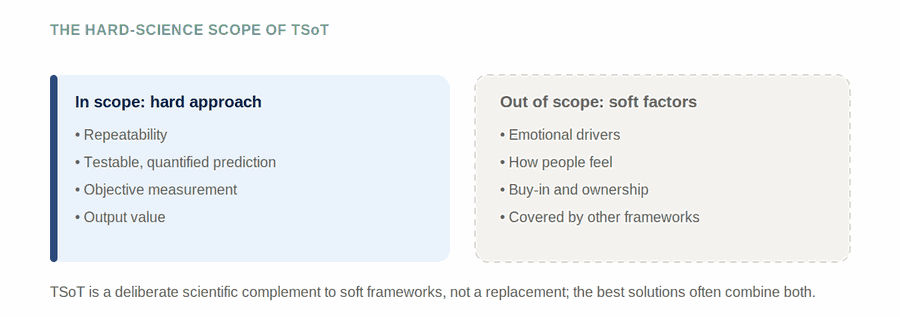
TSoT is also a continuous improvement framework holding several assumptions and several exclusions. The core knowledge captured in TSoT is a theory of hard-science problem solving applied to people in team systems, with the goal of improving the value of output. The reader will notice distinctive new ways of tackling organizing problems that are unique to a TSoT architect using a scientific approach; these approaches are meant to be embraced rather than resisted.
Conceptually, TSoT uses a hard-science approach to its models and philosophies. Hard science implies a methodological approach based on repeatability, testable and quantified predictions, and a high degree of objectivity. A specific soft component not considered in TSoT is emotional drivers, or how a person may feel about a proposed team-system organizing principle.
Why not include feelings in the TSoT models? Because there already exists an abundance of well-established emotional-intelligence and psychology-based team frameworks, so many that it could be argued a balance is needed between the hard and soft organizing views. This work does not dismiss the softer approach; it is designed to provide a balancing scientific complement so that extraordinarily complex situations can be fully evaluated and solved with all available tools. Sometimes a hard approach is best, sometimes a soft approach is best, and more often a combination of the two is best.
It is also important to address soft elements not covered in TSoT, such as buy-in and ownership, when organizing or reorganizing a group of people. These concepts have real-world value, but they are not covered here.
The TSoT Framework
The TSoT Framework is divided into distinct parts, with a core focused on producing real-world results through a repeatable process. This chapter introduces the framework's conceptual machinery: the ideas and language constructs that the rest of the discipline is built upon.
Learning Objectives
On completing this chapter, the reader will be able to:
- Explain positive innovation and why change must be evaluated as better or worse, not merely as change.
- Describe value conflict as the tension between market-facing and organization-facing value, and apply the assumption that resolves it.
- Define the value chain as the union of the demand chain and the supply chain into a single continuum.
- Use the core language constructs: measurable, contradiction, model, pattern, systemic, and syntopical.
- Apply the fluid role, system, and supersystem hierarchy, recognizing that the level depends on the perspective in focus.
- State the five TSoT Principles.
Positive Innovation
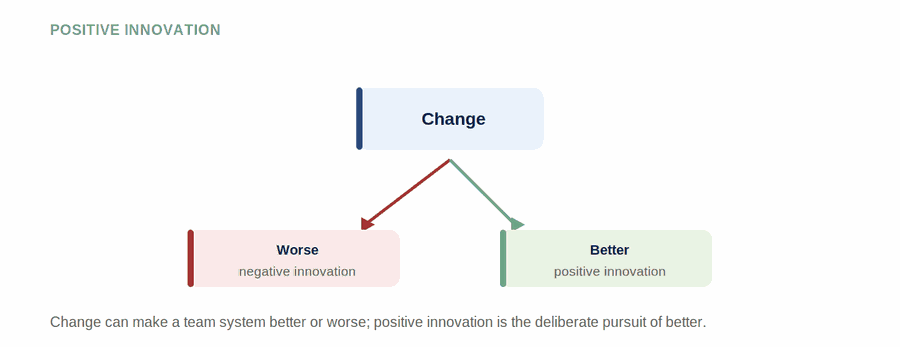
Foundational to TSoT is the concept of positive innovation, meaning that there are better and worse ways to approach forming team systems, such that improvement in a team system's beneficial output, a reduction in its negative characteristics such as cost, or both, is constantly possible.
- Positive Innovation: Since change can make things better or worse, a component of valuable innovation is making things better.
Value Conflict
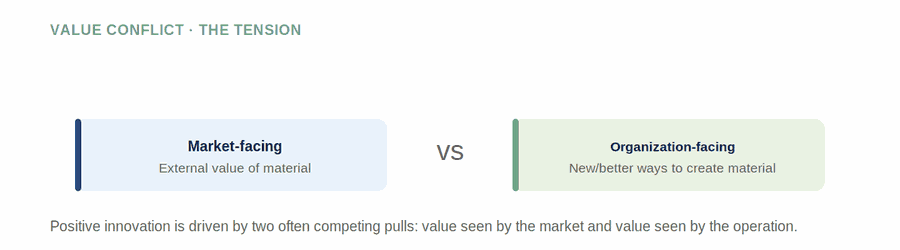

Alongside positive innovation is the concept of value conflict, in which two often competing elements drive positive innovation: a market-facing element and an organization-facing, or process-facing, operating element.
- Value Conflict: Competition between two elements of positive innovation, centered on the balance between market-facing and organization-facing value.
Market-facing value focuses on the external value of material; organization value focuses on new or improved ways of creating material. One perspective among many is that market value occurs in the demand chain and operating value occurs in the supply chain. You could equally say that market value relates to revenue and operating value relates to cost, though as we will explore there are additional factors to both. If you accept that premise, the classic value conflict example is the question: should we charge more, or make it for less?
Depending on your organization, your perspective could differ from these, and you could draw other similarities; the point is to be aware of both components of value, meaning the material value of a team's output compared to the cost to produce that output.
Relativism and the Resolution of Conflict
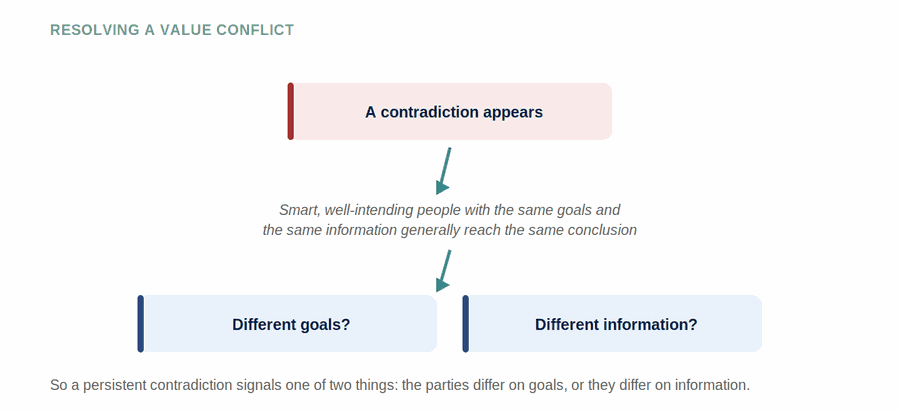
A challenge in the social sciences is the concept of relativism: the idea that there is no final, objective truth, only truth relative to an individual's perspective, shaped by cognitive and cultural influences. The TSoT perspective is that this concern is addressed within value conflict, and rests on a base assumption:
“Smart, well-intending people with the same goals and the same information will generally reach the same conclusions.”
Therefore, when confronted with a contradiction rooted in a value conflict, the assumption is that either the people involved do not share the same goals, or they do not share the same information. This realization can be critical to resolving the conflict.
The Value Chain
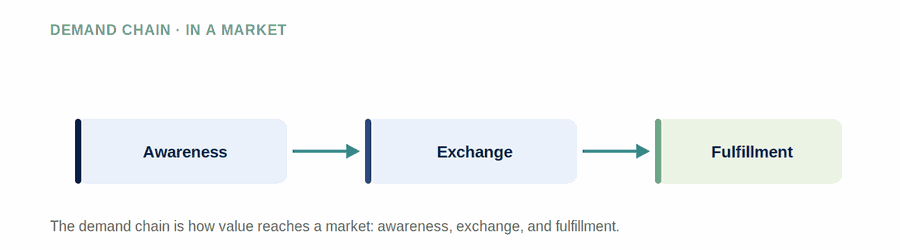

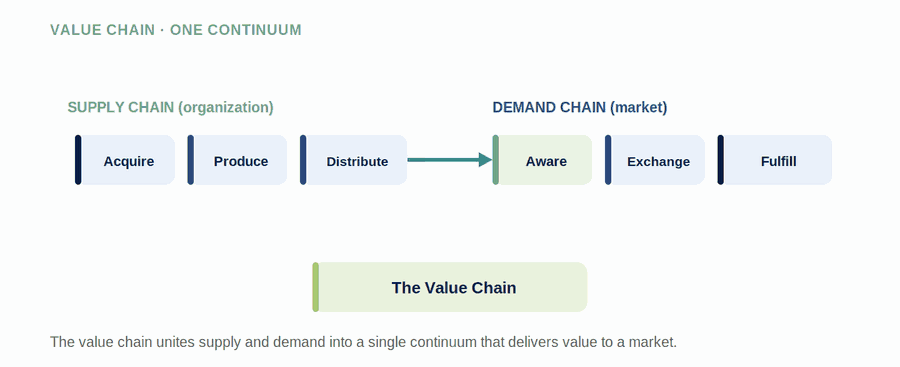
To align market value and operations value, TSoT uses the concept of the value chain, which conceptually combines the demand chain and the supply chain into a single continuum.
- Value Chain: A set of activities to deliver value to a market.
- Supply and Demand: An economic model of price and value determination in a market.
- Demand Chain: Awareness, exchange, and fulfillment in a market.
- Supply Chain: Acquisition, production, and distribution in an organization.
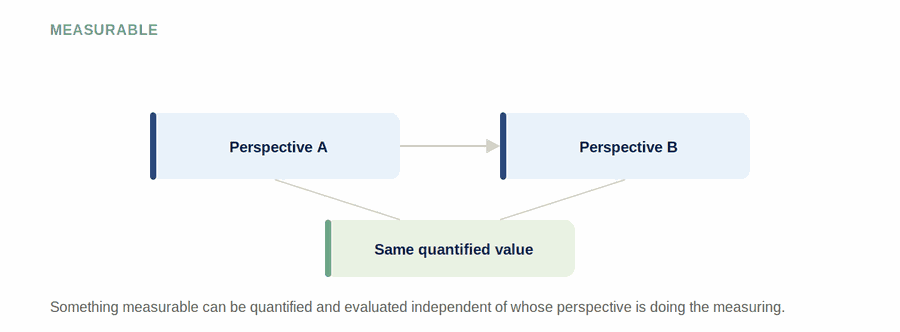
Simply reorganizing how teams work does not in itself guarantee more value than the prior way of operating. The change must bring about more valuable material output, where that improvement can be in production (supply), in consumption (demand), or in some other meaningful, non-theoretical, measurable capacity.
- Measurable: Something that can be quantified and evaluated independent of perspective.
Contradiction
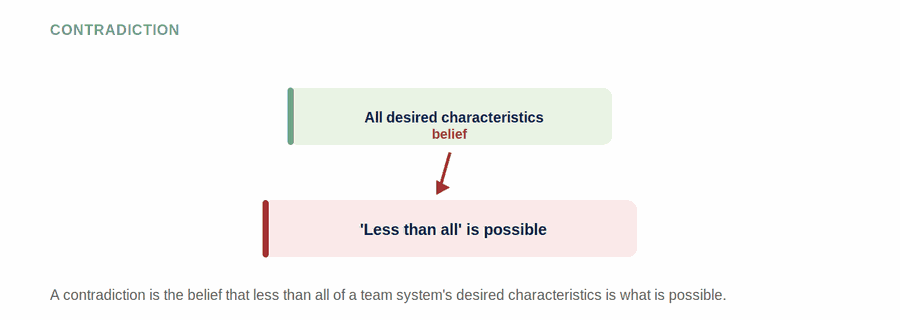
In TSoT, team systems at all levels would ideally hold an optimized means of converting inputs into outputs in the most beneficial and least harmful way possible. This is almost never the actual case. We will spend considerable time framing this gap, but for now it introduces another key language construct: the contradiction.
- Contradiction: The belief that less than all of a team system's desired characteristics is what is possible.
For team systems to evolve along their most efficient paths, each organizational characteristic of the system model must resolve the highest number of contradictions while creating the fewest new ones; must provide the most beneficial effects against the fewest harmful ones; must create the most value with the least harm.
Models and Patterns
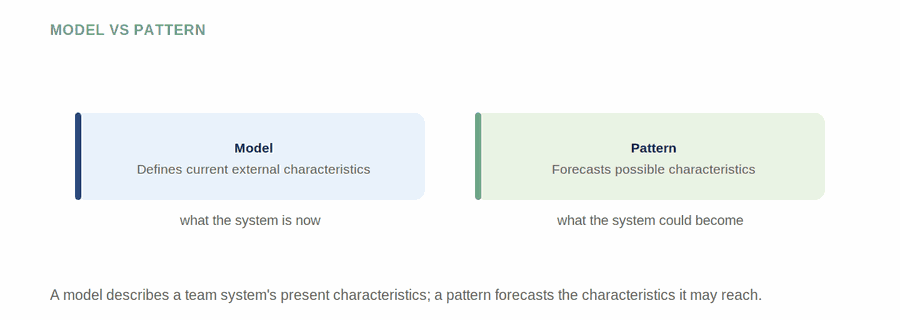
TSoT establishes system-level patterns that translate the reasoning behind how people are organized. The most relevant desired-state reality is established by a systemic analysis methodology, enabling leadership practitioners to advance their field as a profession.
- Model: An organizing construct that defines the external characteristics of team systems, including roles, parts, and processes.
- Pattern: An organizing assessment that forecasts possible characteristics of team systems, including roles, parts, and processes.
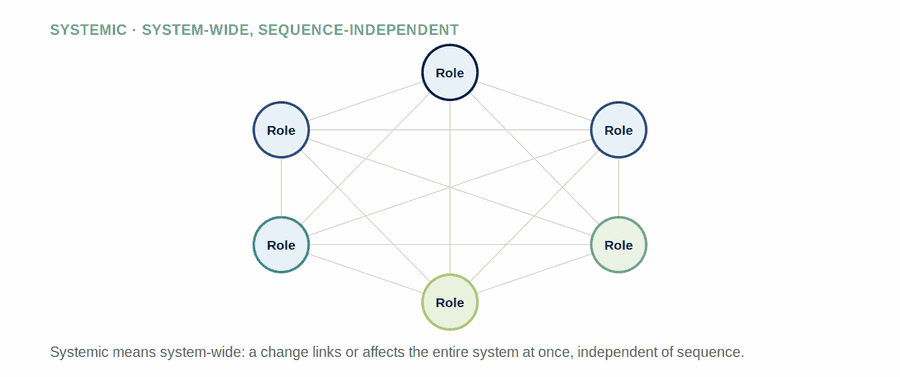
- Systemic: System-wide; linking or affecting the entire system independent of sequence.
Models and patterns provide measurability, context, and direction for determining how to resolve contradictions when designing or redesigning team systems. They lend themselves naturally to this understanding, which is why they form the foundation of TSoT.
Since TSoT unifies a variety of traditional and nontraditional fields, with a focus on the organizing principles that guide organizations, produce products, and steer market interactions, you will see examination and reference to the research of other authors and other concepts. An important aspect of any good framework is building on existing works in new and interesting ways. TSoT also creates a context for value analysis, decision support, requirement analysis (translating business requirements into team designs), competitive advantage, and overall team effectiveness.
The TSoT Principles
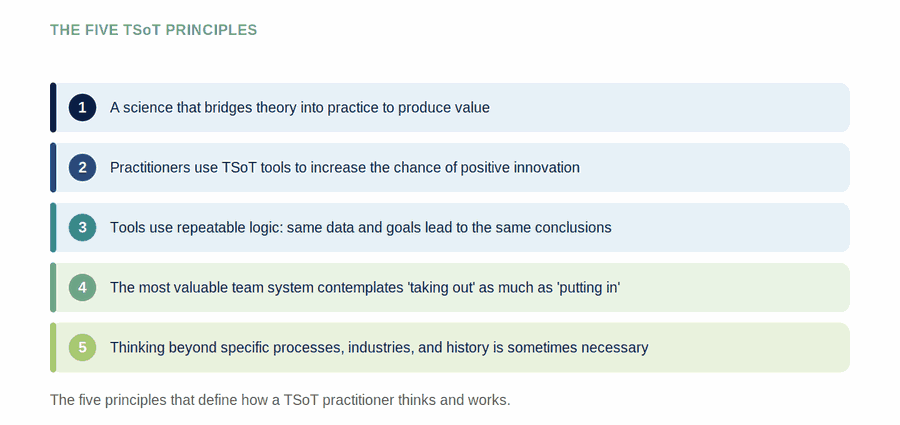
The TSoT Principles are:
Team Systems Do Not Exist in Isolation

The implications of the team system are an integral part of TSoT. Team systems exist all around us: in nature, in the products and machines that humans build, and in the social, philosophical, and economic constructs that humans create. Being able to identify team systems and use the capabilities within them to resolve contradictions, and to create new and better team systems, is a key component of creating value.
Beginning to view isolated problems as part of larger system contradictions helps you create team-system designs using a wider range of strategies that allow for original and innovative results. People and team systems do not exist or function in isolation; they are part of larger systems involving many complex relationships. Setting and examining the appropriate context as you perform your analysis allows you to make seemingly unrelated associations that can result in practical solutions. Such associations are syntopical in nature, and are often linked directly to real-world ideal solutions.
- Syntopical: Viewing a system as the whole, together with the interrelationships among its component parts.
Role, System, and Supersystem: A Fluid Hierarchy
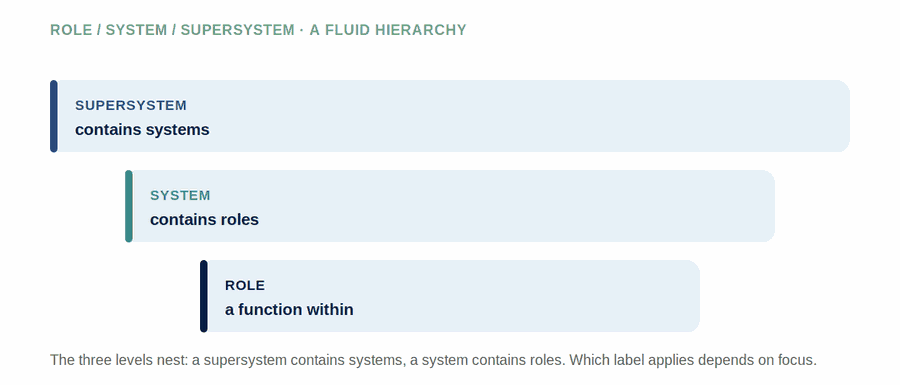

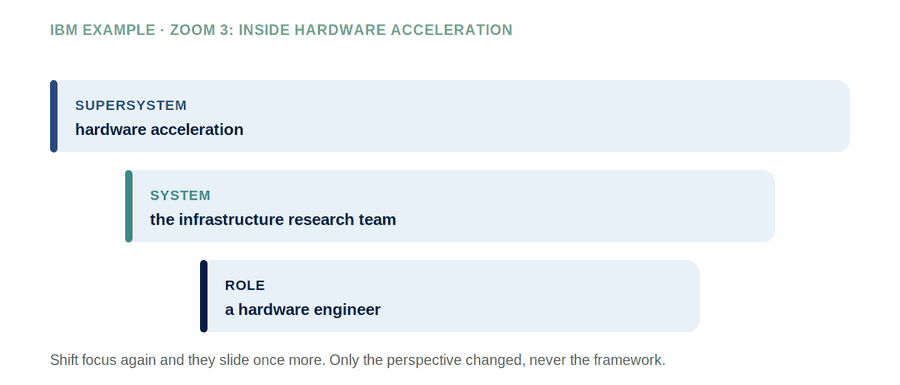
A potentially confusing aspect of the role, system, and supersystem model is that these definitions are meant to be relatively fluid, depending on which perspective is in focus within a hierarchy.
- Role: A function within a system; a person or team that is part of a system.
- System / Team System: A unified, interrelated group of roles; roles organized to produce material output.
- Supersystem: A system made up of systems; an interrelated group of systems able to produce aggregate material outputs.
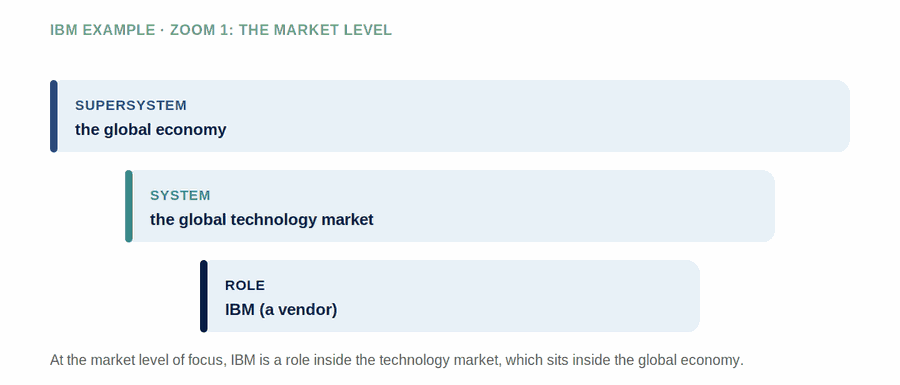
Consider a single worked example at three levels of focus. At an aggregate market level, a company like IBM could be considered a vendor (a role) inside the global technology market (the system) that is part of the global economy (the supersystem).
Moving down the hierarchy to inside IBM, hardware acceleration could be a role within the research and development division, making the definitions role equals hardware acceleration, system equals R&D, and supersystem equals IBM.
At a lower level still, there could be the role of a hardware engineer on the infrastructure research team within the hardware acceleration department.
The Team Solution Algorithm
Every chapter to this point has built toward a single practical question: once you can see a team system clearly, how do you decide what to change? The Team Solution Algorithm is the answer. It is a disciplined sequence of questions that takes any team system and points it in the direction of its ideal, and it is the part of TSoT that turns the framework from a way of seeing into a way of acting.
The algorithm is built on a concept called the Ideal Final Result, or IFR, which defines the direction of a team's evolution toward perfection. The ideal is a team solution that is perfectly beneficial, with no cost, problems, or harms. In many cases this means eliminating the need for the output altogether, with entirely positive consequences. The IFR is not a destination you are guaranteed to reach; it is a true north that tells you which way is forward, so that every change you consider can be judged by whether it moves the system closer to that ideal or further from it.
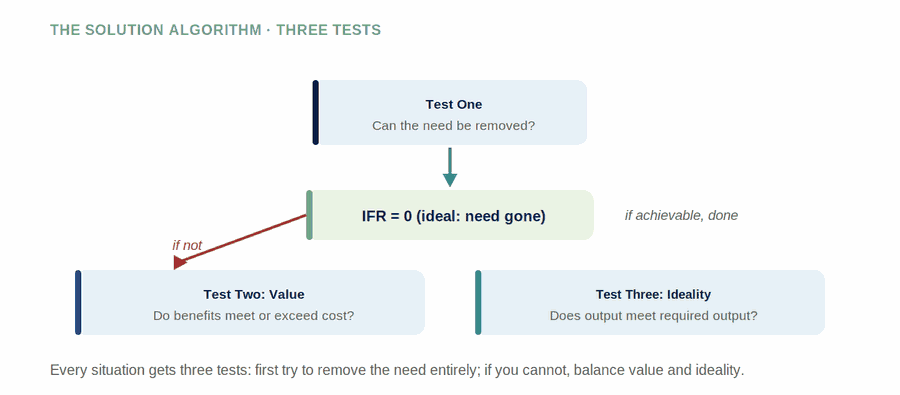
There are three tests to apply to every situation, and they are applied in order. Sometimes a test can be answered in a sentence; more often it requires real research, honest thought, and the willingness to reason through your own biases to reach an objective view. The three tests are not a checklist to be rushed. They are a structured way to keep yourself from leaping to the first plausible change before you have asked whether a better one, or no change at all, would serve the system more.
Learning Objectives
On completing this chapter, the reader will be able to:
- Define the Ideal Final Result and explain why, in its purest form, the IFR equals zero.
- Read IFR = 0 correctly as a resource-positive outcome rather than as a reason to eliminate a team.
- Define the Best Possible Solution and explain each variable that composes it.
- Follow the derivation of ideality and value step by step, and assemble the combined BPS expression.
- Apply the three solution tests in order and identify the delta required to bring a system into balance.
- Recognize the risk of negative change when acting on a Best Possible Solution.
We will carry one example through the entire chapter so that the algorithm is demonstrated and not merely described. Imagine a mid-sized company with a manual invoice-processing team: a group of people who receive supplier invoices, key them into a finance system by hand, check them against purchase orders, and route them for payment. The team is real, the work is real, and the output, paid invoices, is genuinely needed. As we move through each test, we will ask of this team exactly the questions the algorithm demands.
Test One: Removing the Need
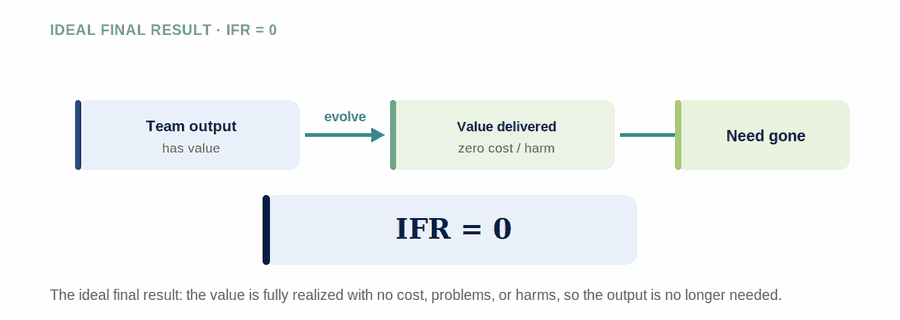
The first test is always the same, and it is the most easily skipped: what would it take to remove the need for this output entirely, in this case? Notice the test is not asking how to do the work better. It is asking whether the work needs to exist at all in its current form, and what would have to be true of the surrounding system for the output to become unnecessary. This is the most demanding question in the algorithm precisely because it refuses to take the team's existence for granted.
In its purest form, the IFR for any system output is the constant zero. An IFR of zero means the supersystem has evolved to provide the value of the team's output without any cost, harms, or problems at all, so that the output is no longer needed as a separate component of the supersystem. The value still exists; it has simply been absorbed so completely that no dedicated effort is required to produce it.
- Ideal Final Result (IFR): The perfect combination of a system's configuration in which all value is recognized without any cost, problems, or harms.
Applied to our invoice team, Test One does not ask how to make manual keying faster. It asks what would have to be true for the company to receive the value of correctly paid invoices without anyone keying anything at all. Perhaps suppliers could submit structured electronic invoices that match against purchase orders automatically, with exceptions alone reaching a human. Perhaps the purchasing system could generate the payment instruction at the moment of order, so that an invoice is never separately processed. Each of these moves the output toward its IFR, and the practitioner is obligated to consider them seriously before settling for a faster version of the manual work.
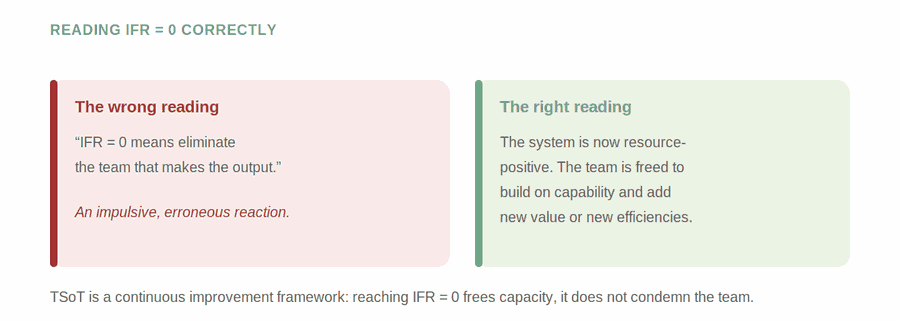
Here a warning is essential, because the IFR concept is so often misread on first encounter. Reaching an IFR of zero is not a recommendation to eliminate the team of people who produce the output. That is a consistent but erroneous impulsive reaction, and acting on it misunderstands the entire framework.
Remember that TSoT is a continuous improvement framework. When an IFR reaches zero, it means the system has evolved to being resource-positive: the value is now obtained for free, and the people who once produced it are themselves the freed resource. They can be assigned new work that builds on the capability and knowledge they already hold, adding new value or creating new efficiencies elsewhere. The invoice team that automates itself out of manual keying is not a team to be dissolved; it is a team that now understands the company's entire procure-to-pay flow intimately, and that understanding is exactly what you want pointed at the next contradiction.
This can be a difficult idea to accept, because it stretches the embrace of philosophically lean and efficient to its farthest conception. But understanding why the ideal sits at zero is key to understanding TSoT. As systems form and evolve, their ideal state improves the closer they approach zero, meaning the closer they come to delivering ideal benefits at perfect efficiency with no costs, problems, or harms. Zero is not emptiness; it is the point at which value has become effortless.
When the Ideal Is Not Yet Reachable: Variables and Formulas
Often, after honest analysis, the IFR of zero cannot be realized in the real world at this moment. A critical discipline here is to reach that conclusion only after the analysis, never by assumption. It is far too easy to declare the ideal impossible because it is inconvenient. But once you have genuinely established that the need cannot yet be removed, the algorithm turns to its second question: given that the system must exist for now, what is the best it can be?
- Best Possible Solution (BPS): The best possible combination of a system's configuration given that the system exists; the best next step in the direction of the IFR.
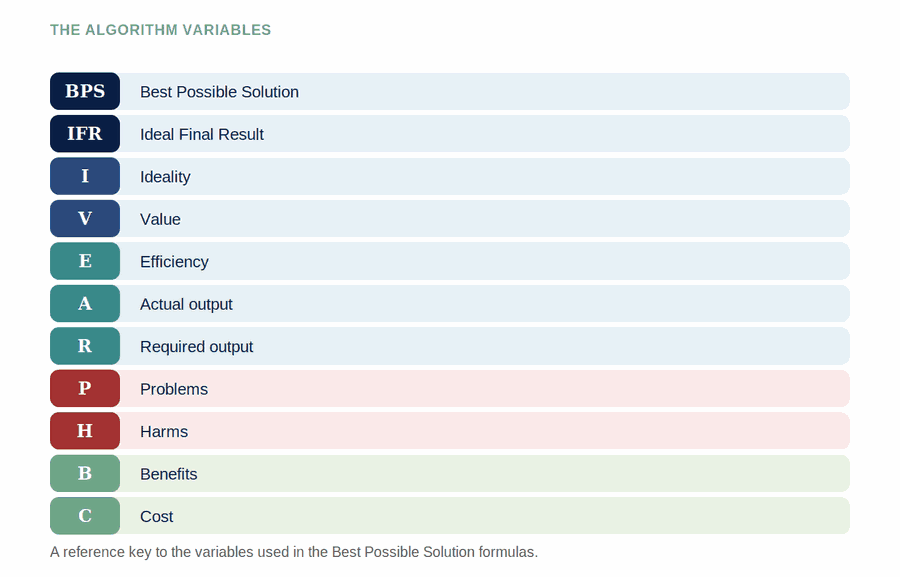
The BPS is not a compromise or a consolation prize. It is the most that can be achieved from where the system stands, and it is always understood as a step in the direction of the IFR rather than a resting place. To reason about it precisely, TSoT gives each contributing factor a name and a symbol. The legend below collects every variable used in the formulas that follow; it is worth returning to as the expressions build, so that no symbol is ever read as a mystery.
The Best Possible Solution Formulas
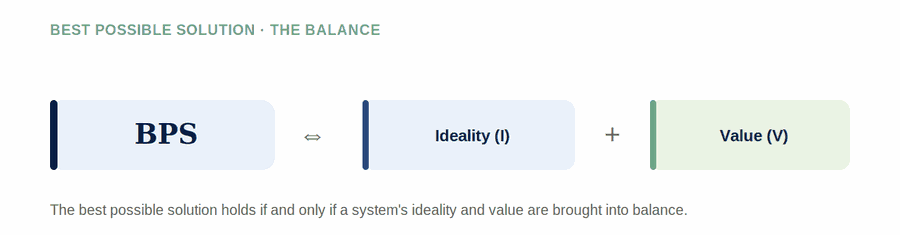
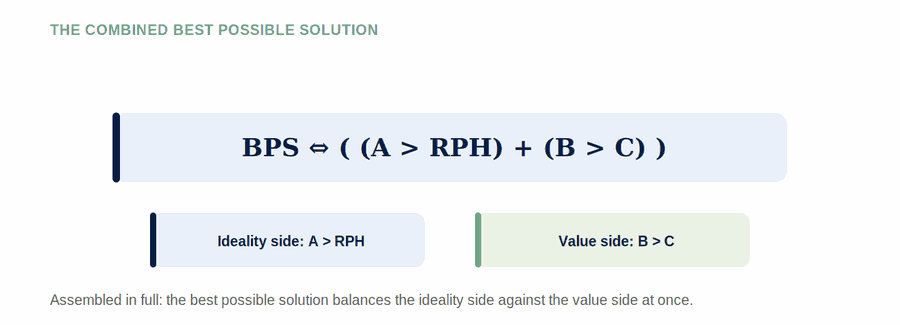
A system's Best Possible Solution is the process of bringing its ideality and its value into balance. Neither alone is sufficient: a system can be exquisitely efficient at producing something that is not worth producing, or can produce something valuable at a cost that swamps the benefit. The BPS is reached only when both sides are satisfied together. Throughout these expressions, the symbol joining the two sides is the biconditional, read as if and only if, which means the statement on the left holds exactly when the statement on the right holds, in both directions.
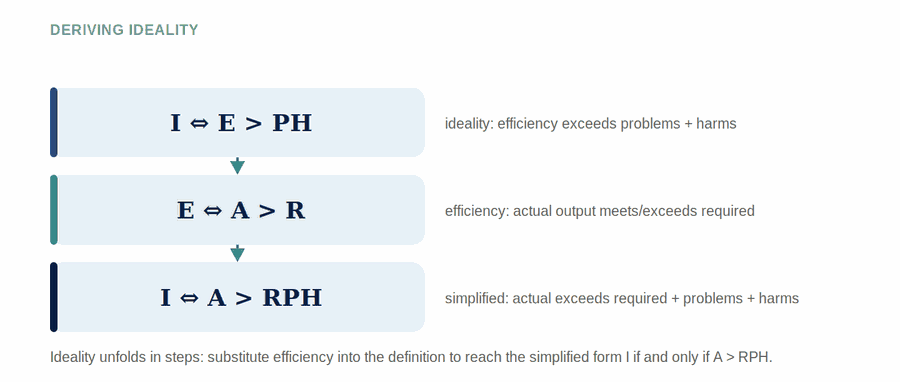
Ideality and value each unfold from simpler definitions, and it is worth following the unfolding rather than memorizing the result, because the derivation is where the meaning lives. Begin with ideality. A system's ideality is reached when its efficiency exceeds its problems and harms; an ideal system, in other words, delivers the highest efficiency while introducing no problems or harms of its own. Efficiency in turn has its own definition: an efficient system delivers actual output equal to or greater than its required output. Substituting that definition of efficiency into the definition of ideality, and simplifying, gives the compact form: a system's ideality is reached when its actual output equals or exceeds its required output plus any problems or harms incurred in reaching that output.
The simplified form is the one you will use most, but it carries the full meaning of the steps behind it. It says that being ideal is not merely producing enough; it is producing enough after honestly accounting for the problems and harms the production itself creates. A team that hits its output target while generating rework, burnout, or downstream defects has not actually reached the required level once those harms are subtracted.
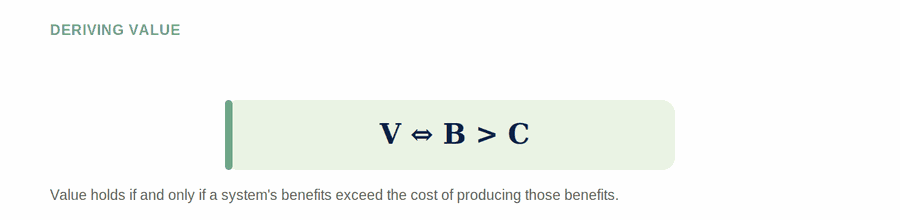
Value is the second half of the balance, and its definition is more familiar. A system is valuable when its benefits exceed the cost of those benefits; the highest-value system delivers the greatest benefit at the lowest cost. This is the side of the equation that connects most directly to the market-facing view of value from the previous chapter.
Substituting all the definitions into the original balance gives the combined expression for the Best Possible Solution. Read it as a single statement with two halves held together: a system reaches its best possible solution when its actual output exceeds its required output and any problems or harms on the ideality side, and its benefits exceed its costs on the value side, both at once.
For the invoice team, the combined expression becomes a concrete pair of questions. On the ideality side: does the team actually process the invoices the company needs processed, after accounting for the errors, late-payment penalties, and rework its current process generates? On the value side: do the benefits of having paid, reconciled invoices exceed what the team costs to run? Holding both questions at once is what keeps the analysis honest, and it is exactly what Tests Two and Three formalize.
Tests Two and Three: Finding the Delta
If the ideal cannot yet be reached, the work becomes finding the gap and naming it precisely. The second and third tests each isolate one side of the balance and ask first whether it is satisfied, and if not, what change, what delta, would satisfy it. The delta is the heart of the practical output of the algorithm: it converts a vague sense that something is wrong into a specific statement of what must move and by how much.
Test Two: Value

For value, the question is direct: does the system produce actual output benefits equal to or greater than its costs? If the honest answer in this situation is no, the next question follows immediately: what change in the output is required to make its benefits equal to or greater than the cost of producing them? That change can come from raising the benefit, from lowering the cost, or from both together, and naming which lever you intend to move is part of the analysis, not an afterthought.
For the invoice team, suppose the benefits of timely, accurate payment, preserved supplier relationships, captured early-payment discounts, avoided penalties, do not currently exceed the fully loaded cost of the manual team. Test Two then asks what delta closes that gap. Perhaps capturing more early-payment discounts raises the benefit; perhaps reducing the hours spent on manual keying lowers the cost; perhaps both. The test does not yet tell you how to make those changes, but it tells you, precisely, which quantities must move for the value side to come into balance.
Test Three: Ideality
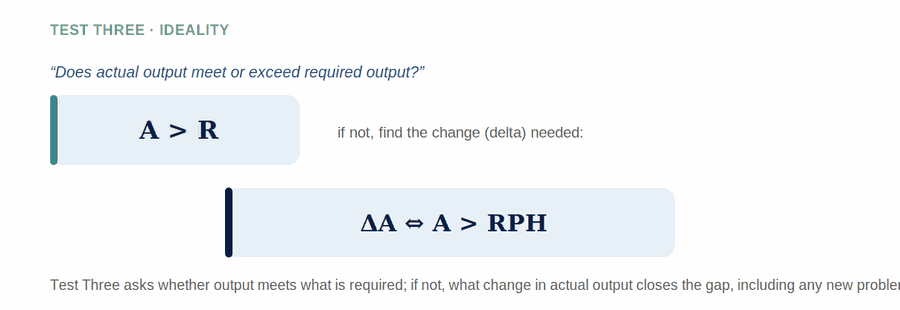
For ideality, the question mirrors the value test on the other side of the balance: does the system produce actual output equal to or greater than its required output? If the answer in this situation is no, the next question is what change in the actual output is required to make it equal to or greater than the required output, while also accounting for any new problems or harms introduced in reaching that level. That final clause matters: a delta that hits the output target by creating fresh harms has not truly satisfied ideality, and the algorithm forces you to keep those harms in view.
If our invoice team is failing to process the required volume during peak periods, Test Three asks what change in actual output would close that gap, counting honestly any new problems the change might bring. Adding rushed temporary staff might raise raw throughput while increasing error rates, which the required-output-plus-problems-and-harms form explicitly penalizes. The test thereby steers you away from changes that look like improvements on a single number but degrade the system once their side effects are counted.
The Outcome

On completing the analysis, you will arrive at one of two destinations. Either you will have found that the ideal is reachable, the solution IFR = 0, or you will hold a clear gap analysis: a specific statement of which variables must change, and in which direction, to bring the system to its Best Possible Solution. Both are successful outcomes. The first removes a need; the second gives you a precise, defensible target for the change work that follows.
The next step after identifying the needed result is to identify the optimal options for the change that will bring the system into balance, and this is where care is most rewarded. When you are working toward a Best Possible Solution rather than the IFR, there is substantial risk of making the system worse through a poorly chosen change. A delta tells you what must move; it does not guarantee that the first method you reach for to move it will not introduce new problems, new costs, or new harms that leave the system further from its ideal than before. Selecting the change deliberately, with the full balance in view, is the discipline that separates analysis from mere tinkering, and it is the subject the following chapters develop.
Patterns of Team System Evolution

The previous chapter gave us an algorithm for deciding what to change in a team system at a single moment. This chapter steps back and watches the system move through time. The patterns of team system evolution provide a way to look at teams from various perspectives and at various points in their lives, in order to understand what is happening to them as they age, how they can evolve, and how they can be deliberately crafted to behave in the future. Where the algorithm is a snapshot, the patterns are the motion picture.
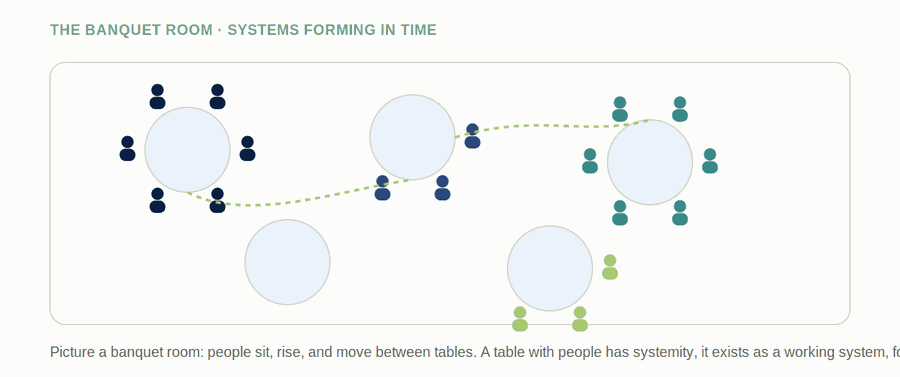
Begin with an image. Picture a large gathering of people in a banquet room filled with big round tables and chairs. Over time, some people sit down at the tables while others stand or wander. Sometimes a chair holds a person, sometimes it sits empty; sometimes a whole table is full, sometimes deserted. All the while people keep moving, talking, and settling in and out of seats. Watch long enough and you begin to notice pathways worn between the tables, routes that make it easier to move about the room. You see certain tables hold the same people for long stretches, while others never fill at all. The room is a forever changing, evolving landscape.
Now suppose these were not idle guests but teams of people organized to produce output. There would be reasons people sat at one table rather than another, and reasons someone might switch tables. Watched over time, those reasons would resolve into identifiable patterns. And while a table has people working at it, that team system has systemity: it exists, at that point in time, as a real system in the world.
- Systemity: The quality of a system to exist at a point in time in the real world; a system that can produce output has systemity, while a system that cannot produce output does not.
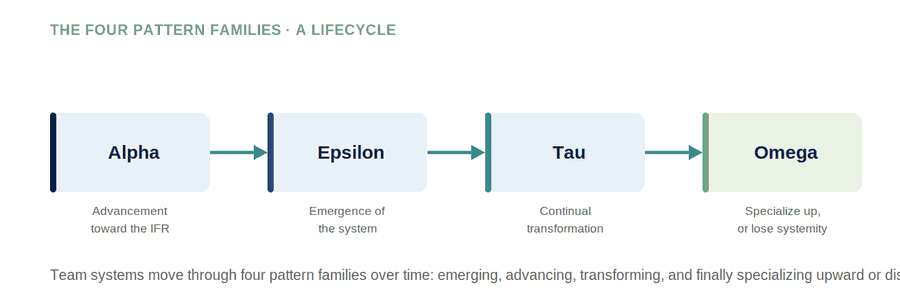
These patterns carry an evolutionary cycle of their own, one that lets a careful observer predict a system's logical next steps. They fall into four families, and the rest of this chapter takes each in turn: Alpha, Epsilon, Tau, and Omega.
Learning Objectives
On completing this chapter, the reader will be able to:
- Define systemity and explain why it is a stable state in the short run but a transitional one in the long run.
- Describe the four pattern families, Alpha, Epsilon, Tau, and Omega, and the stage of evolution each governs.
- Identify the six conditions of emergent systemity and the elements of functional and structural alignment.
- Recognize the Tau patterns of transformation, including asymmetrical role modernization and specialization.
- Anticipate a system's Omega transition, either into a specialized role within a supersystem or into the loss of systemity.
To keep the patterns concrete, we will follow one team system through its whole life. Imagine the customer-support function of a young software company. At the start it is a handful of people answering every kind of question that arrives, by email, by phone, by whatever channel a customer happens to use. We will watch this small team emerge, advance, transform, and finally arrive at its own Omega, and at each stage we will name the pattern that governs what is happening to it.
Alpha Patterns: Advancement Toward the Ideal
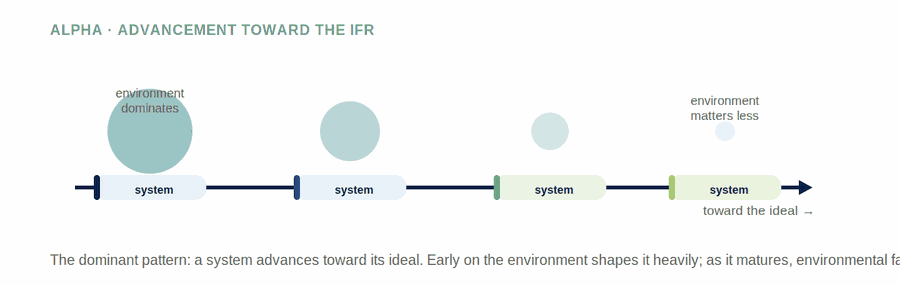
The Alpha pattern is the first pattern and the dominant one. It frames the overall meaning of a system's existence: teams strive for advancement in the direction of their contextual ideals, and for prolonged existence along the way. Every other pattern operates inside this larger pull toward the ideal.
System advancement is the capacity to organize and improve into configurations that, over time, produce more beneficial output with fewer problems or harms, or more valuable output at lower cost, or both. There is an important secondary observation buried in the Alpha pattern: when a team system is first forming, external environmental factors have an outsized effect on defining it, but as the system moves closer to its ideal state, those environmental factors affect it less and less. A mature system increasingly defines itself.
Our young support team lives this pattern from its first day. Early on it is shaped almost entirely by its environment: whatever customers happen to ask, whatever channels they happen to use, whatever crises the product happens to throw off. It has little shape of its own. The Alpha pattern is the steady reminder, to the team and to the practitioner watching it, that improvement is always possible, whether by increasing the benefit the team delivers, reducing the problems its existence creates, raising the value of its output, or lowering the cost of producing it. Alpha is less a single mechanism than a standing orientation: assume there is a better state, and look for it.
Epsilon Patterns: The Emergence of a System
If Alpha is the direction of travel, the Epsilon patterns describe how a system first comes into being at all. They represent the bounds of the system: the emergent structures and roles necessary for a system to be distinguished from mere randomness, with attention to systemity, function, and structure. The Epsilon patterns answer a deceptively simple question: what must be true for a working system to exist where, a moment before, there was only a crowd?
The Pattern of Emergent and Maintained Systemity
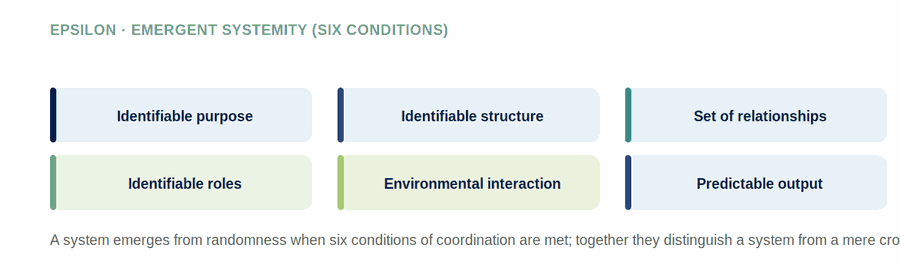
It is possible to tell a team system apart from a non-system by analyzing its composition. Systemity is achieved when roles are successfully organized to coordinate their interactions, with one another and with the environment, well enough to produce output. That coordination shows up as six identifiable things.
These six conditions, an identifiable purpose, structure, set of relationships, roles, environmental interactions, and the predictable creation of output, are what separate our support team from the founders simply answering emails between other tasks. The moment those answers acquire a purpose, a structure, defined roles, and a predictable output, a system has emerged. But systemity, once gained, is not permanent. According to the Omega pattern we will reach shortly, over time a system will either achieve ideality or lose systemity. Systemity is a stable state in the short run and a transitional one in the long run; in the exceptionally long run, every team system eventually loses it.
Systemity is most rewarding in analysis for what it reveals about the variety of roles that exist across the parts of a system. Because there is no one-to-one relationship between roles and systems, similar roles very likely serve many different systems and supersystems. Recognizing this, and being willing to change roles, reuse roles, or create new roles specific to a desired output, is a frequent source of innovative and highly beneficial organizing solutions.
The Pattern of Emergent Functional and Structural Alignment

For a team system to exist, it must possess the structure and function needed to convert inputs into outputs. That structure has to be aligned to four capabilities: collecting and receiving input data, processing and transforming that data, producing material output, and exercising control, the elements that measure and adapt to internal and external conditions.
When you examine a team system, confirm first that all the necessary roles are present and comprehensible. When you examine its ideality, study the interactions between roles and look for contradictions or possible efficiencies; look for lines of completeness and for opportunities to bring in more ideal roles; and identify any roles that do not contribute to the output transformation, asking honestly whether they are necessary. In our support team, this is the stage where someone notices there is no one actually tracking whether issues get resolved, a missing control element, and the structure is adjusted until the four capabilities are all genuinely present.
Tau Patterns: Continual Transformation
The Tau patterns forecast the non-linear, asymmetrical developmental paths a system and its roles follow over time. Where Epsilon explains how a system begins, Tau explains how it keeps changing once it exists, as it strains toward a higher-order state. That transition can take several forms: becoming part of a larger system, having internal roles mature until they are fully transferable as independent systems in their own right, or simply growing more mature overall. There are five Tau patterns, and together they describe most of what happens to a system across the long middle of its life.
Increasing and Changing Relationships Over Time
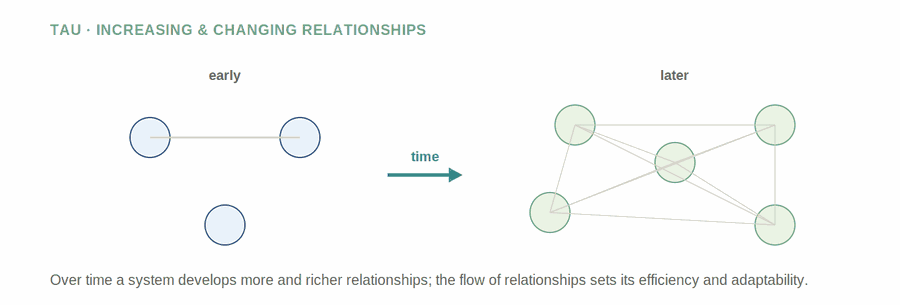
Team systems are, at bottom, the coordination of roles to turn input into output, and the connections between roles and between systems are called relationships. Relationships change within systems over time, and systems steadily develop more of them, reaching out to gain and to provide access to ever more connections. This exchange of relationships is itself coordinated, in both the short and long run, and it shapes the functional, structural, and ideal states of every system involved. The flow of relationships through a system largely determines its efficiency and its adaptability; treated as a resource, relationships are most valuable when they can be leveraged quickly, wherever and whenever they are most needed.
As our support team grows, it stops being an island. It builds relationships with engineering to escalate bugs, with sales to understand what customers were promised, with product to feed back what users struggle with. When you examine a system, ask whether it has enough of the right relationships for every role to work efficiently across the whole system and supersystem, and look for artificial barriers, or for places where a new relationship would yield more ideal or valuable output.
Increasing Internal and External Coordination
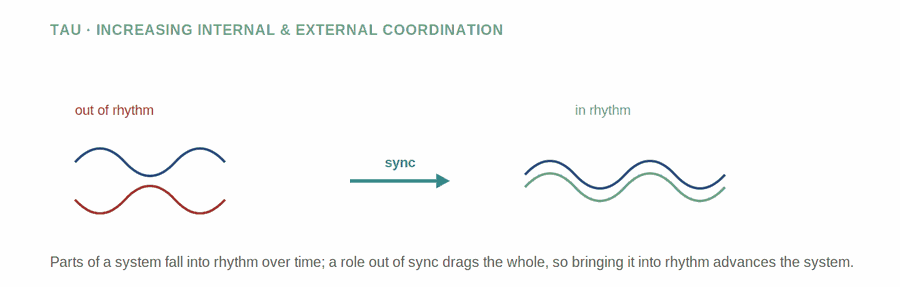
This pattern concerns the interaction among the roles of a system and its supersystem. Over time, well-evolved systems need less explicit structural and functional coordination, because their parts have learned each other's rhythm. The reverse is costly: if one part of a system falls out of rhythm with the others, running at lower efficiency, for instance, it drags the efficiency of the whole system down with it. The out-of-step role must be brought back into rhythm for the system to rebalance and advance.
Another way to see this pattern is that parallel or complementary systems tend to harmonize over time as they advance toward ideality, often by synchronizing their rhythm with the systems around them. The practitioner's task is to find where a system is out of rhythm, with itself, its roles, or the supersystems it participates in, and to consider whether bringing it into rhythm would improve it. When our support team adds a weekend shift that works in isolation, unaware of what the weekday team is seeing, the resulting friction is a rhythm problem, and synchronizing the two is the improvement.
Asymmetrical Role Modernization
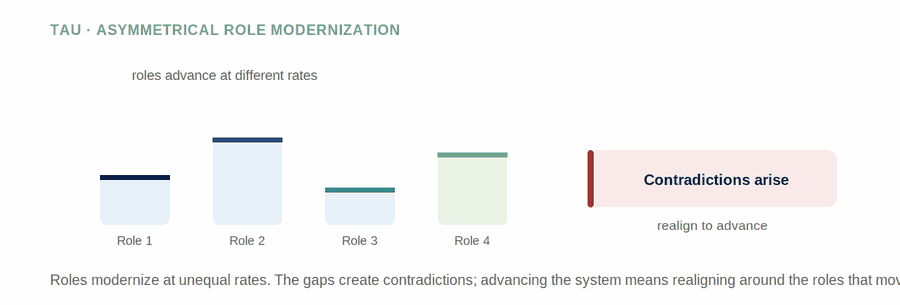
The roles within a system advance at unequal rates, and the more unequal that development, the more complex the system becomes. Large systems can grow extraordinarily complex precisely because each role can modernize independently of the others. The result is contradictions, which in turn generate problems for the system's future development. Advancing the system often means simplification: the continual realignment of roles and structures to take advantage of the modernizations that have occurred. The system can only develop logically once these contradictions are resolved, and sometimes resolving them sends the system evolving in a different direction, or toward a different purpose, than anyone originally expected.
Constantly analyze the roles and structure for evolutionary possibilities, remembering that the system is moving through time rather than standing still. When one role advances, watch carefully for the disruptions, new capabilities, and new contradictions it creates with the others. It is entirely acceptable for a role to advance even when the whole system cannot advance in step; that asymmetry is expected, and is part of the natural evolutionary process. In our support team, one agent becoming expert at the billing system races ahead of the others, and the team must realign around that new strength rather than pretend everyone advanced equally.
Asymmetrical Role Specialization
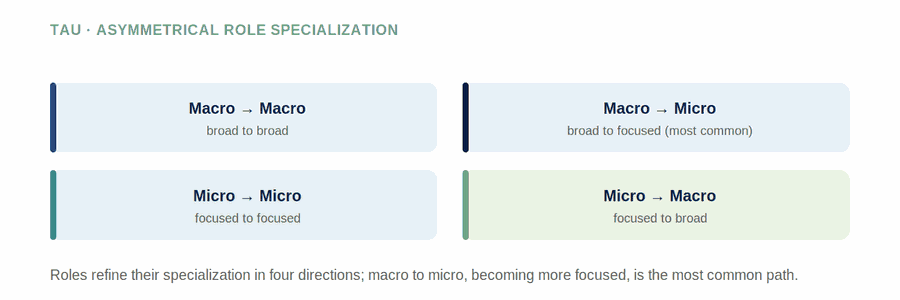
As roles evolve, they refine their specializations independently, producing more and more roles that are better at particular functions. Sometimes roles develop redundant specializations, which lets one be retired while the other propagates more broadly. Roles generally specialize in one of four directions: macro to macro, macro to micro, micro to micro, and micro to macro. By far the most common is macro to micro, a role becoming more focused and better at a smaller number of functions.
A general accounting role becomes an expert in corporate taxes; a general system-support role becomes an expert in one application; a general labor role becomes an expert in a specific function. This pattern also suggests that as roles specialize, they propagate to other systems: as a specialized role's quality rises, so does demand for it across team systems. Analysis here looks for mature specialized roles that could improve other systems needing the same specialization but not yet evolved enough to grow it themselves. Distributing quality specializations across systems, and improving interoperability between them, advances many systems at once in cost-effective ways. Our support team's billing expert, once proven, is exactly the kind of specialized role another part of the company will want to borrow.
Increasing Dynamism Through Information Saturation
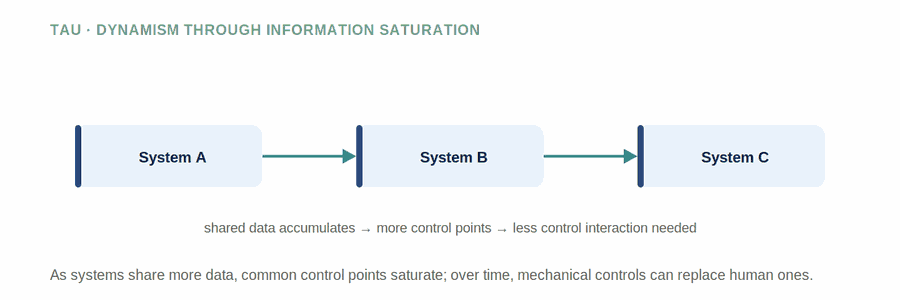
As more relationships form between systems, more data flows between them, and the systems develop more functional and structural commonalities. That gives each system more data, and more data at each structural point, which in turn allows more points of comparison and more control measurements. Because roles evolve at different rates, a system that grows more dynamic without matching growth in controllability will develop cross-system contradictions that must be solved before it can advance. And because more systems are being created with more of the same common roles, systems are steadily saturated with common data and adopt more common control mechanisms over time.
Information saturation means more data sits at each control point, which suggests that, in aggregate, less active control interaction is needed over time. Look for opportunities to substitute mechanical controls for human ones, and, as more cross-system control points appear, look for adaptive controllability opportunities and for cross-system points where roles can relate. When our support team's ticketing data becomes rich enough that the system can route and prioritize on its own, a control that once required a human supervisor can become mechanical.
Omega Patterns: The Final Transition
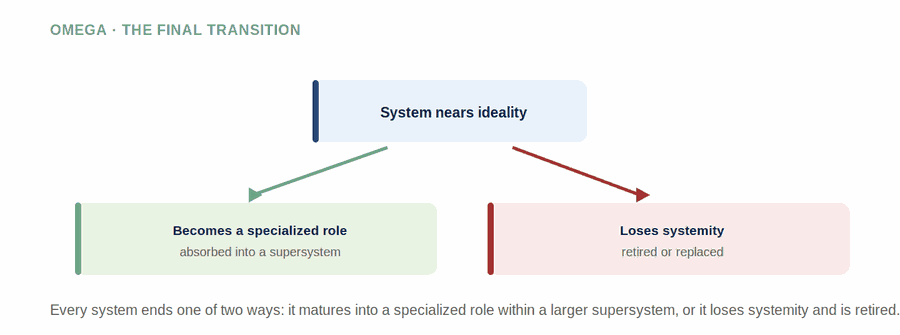
The Omega pattern represents the final nature of a system. It predicts the system's eventual transformation into a role within a higher-order supersystem, or its conclusion in the loss of systemity. Every system, watched long enough, arrives here.
Once a system has developed to its ideal potential, it can be merged into a supersystem, where it becomes a specialized role of that larger system. If the function of the merged system already exists in the supersystem, the original may become redundant and be eliminated. The natural next evolutionary step for a system that has approached ideality is integration into a higher-order supersystem. Clearing the barriers to that integration, and letting it happen, is often a good way to keep the larger supersystem advancing toward its own ideal while lifting the lower-order roles and systems beneath it.
As a system approaches ideality, then, it eventually becomes able to make the transition to a specialized role within a larger system, and after that transition it continues to specialize. Keep looking for the barriers to further specialization: find the contradiction preventing it and resolve it. This demands very specialized knowledge of the value of the outputs the system provides, and a solid understanding of its internal process flows and functional relationships. And if a system cannot make the transition to a higher-order supersystem, and cannot be improved any further toward the ideal, then retirement or replacement should be considered, with the goal of finding a team system that can be improved instead.
Our support team reaches its own Omega in one of two ways. In the hopeful case, it has matured so thoroughly, with its specialized roles, its rich relationships, its mechanical controls, that it is absorbed into a larger customer-operations organization as a specialized, well-understood role, lifting the whole operation as it joins. In the other case, self-service tools and automation eventually deliver the value the team once provided, the team loses its systemity, and the right move is to redeploy its people, who now understand the customer better than anyone, to the next contradiction worth solving. Either way, the Omega pattern reminds us that the end of a system's systemity is not a failure of the framework but the natural close of an evolutionary cycle, and usually the opening of the next one.
Defining the Ideal Final Result
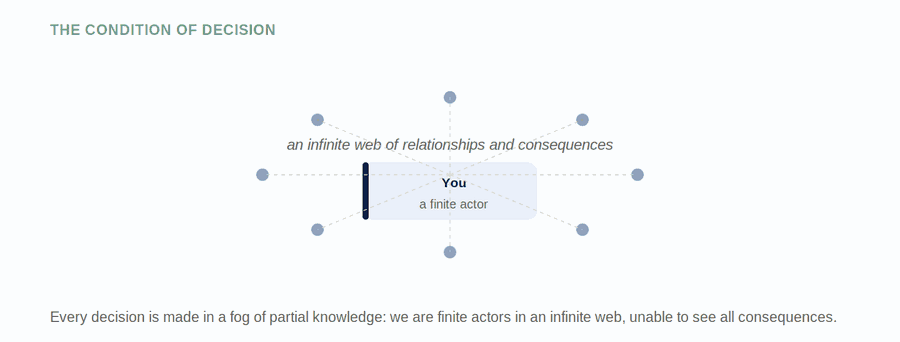
Human beings face a fundamental challenge in every decision we make: we lack complete information. We cannot see all consequences, understand all contexts, or predict all outcomes. We are making choices in a fog of partial knowledge, trying to navigate toward optimal results without a complete map. This is not a flaw in our analysis but a condition of our existence. We are finite actors operating in an infinite web of relationships and consequences.
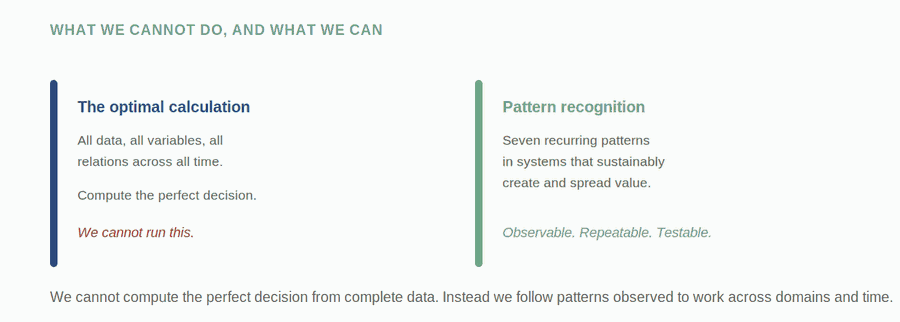
There exists, at least conceptually, what we might call the optimal calculation. If one had access to all data, all variables, all relational contexts past, present, and future, one could compute the optimal decision in any situation. One could maximize what we term the derivative of value: the rate at which benefit increases and spreads through all systems and relationships. But we do not have this data. We cannot run this calculation. So what do we do?
The answer comes from pattern recognition across complex systems. Seven recurring structural patterns appear consistently in systems that sustainably create and distribute value. These patterns were not invented theoretically; they were discovered through careful observation of what actually works across domains, industries, and timeframes. They are observable, repeatable, and testable.
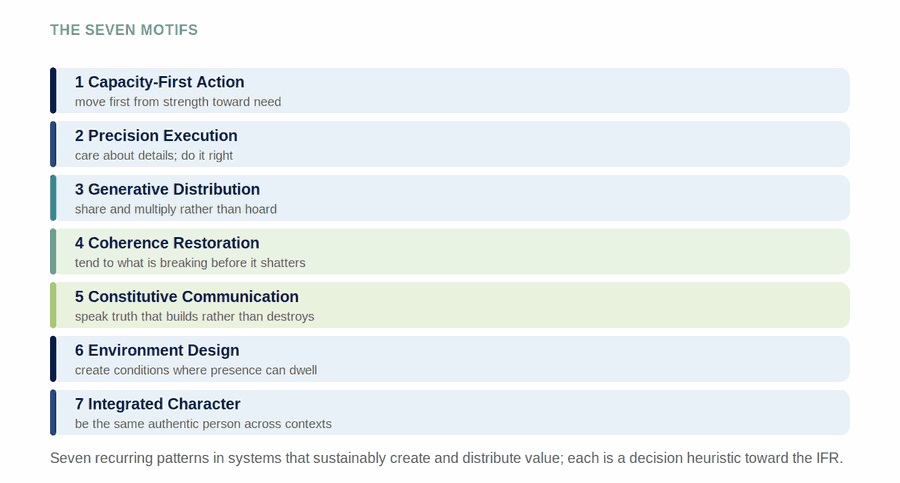
These seven motifs function as universal principles applicable across any system context. They work as analytical tools for understanding any system or text. They work as structural principles for organizing teams and institutions. And most importantly, they work as decision heuristics for determining whether a proposed change moves toward or away from the Ideal Final Result.
When you cannot know everything, follow these patterns. They are designed to preserve and increase relational potential even in uncertainty.
- Optimal Standard: Follow these patterns to maximize the derivative of value across all relationships.
- Minimum Standard: At bare minimum, do not violate these patterns in ways that reduce relational potential.
Learning Objectives
On completing this chapter, the reader will be able to:
- Explain why every decision is made under incomplete information, and what the optimal calculation would require.
- Define the derivative of value and distinguish a positive derivative from a negative one.
- Name the seven motifs and state the decision heuristic of each.
- Recognize each motif's inverse, the violation, and the system damage it produces.
- Map each motif to the TSoT variable it operationally defines, and state the complete qualitative IFR.
The Derivative Principle

The concept of the derivative from calculus provides the organizing logic for the Seven Motifs. In calculus, the derivative measures the rate of change, how fast something is increasing or decreasing at any given moment. Applied to value creation, it gives us a single guiding quantity.
- Derivative of Value: The rate at which benefit increases and spreads across all relationships in a system. A positive derivative means value is accelerating; a negative derivative means value is decelerating or contracting.
The goal of any system change should be to maximize this derivative: not just to create value in a single transaction, but to increase the rate at which value grows and spreads. The Seven Motifs are patterns that, when followed, tend to produce positive derivatives, and when violated, tend to produce negative ones.
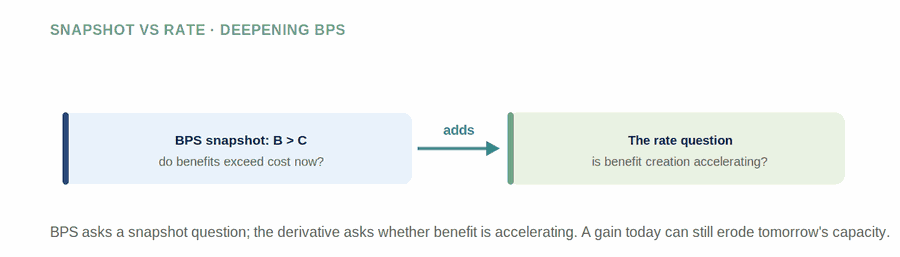
This connects directly to TSoT's BPS formula. When we ask whether benefits exceed costs, B greater than C, we are asking a snapshot question. The derivative principle asks a different one: is the rate of benefit creation accelerating or decelerating over time? A decision might produce immediate benefits that exceed costs while simultaneously reducing the system's capacity for future benefit creation. The Seven Motifs help identify exactly these dynamics.
Each motif is presented the same way: as a universal principle, a decision heuristic, and a core pattern, followed by how it operates in systems, how it integrates with the TSoT variables, and what its inverse, its violation, looks like. The inverse matters as much as the pattern, because recognizing the violation is often how you first detect that a system is producing a negative derivative.
Motif One: Capacity-First Action
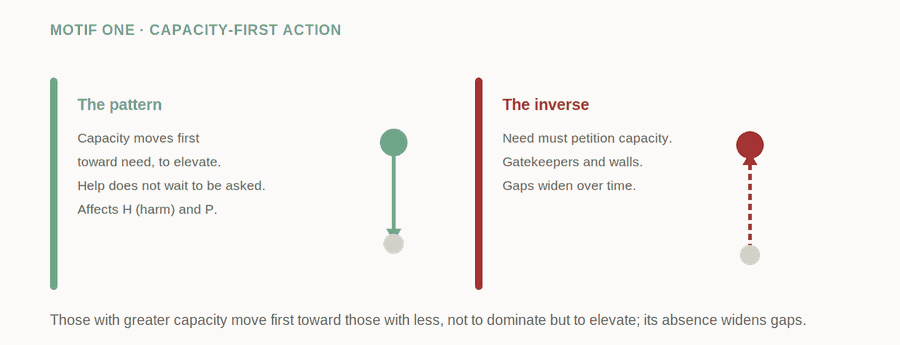
Capacity-First Action describes any purposeful movement from greater capacity toward lesser capacity with the intent of elevation or aid. It is initiative that flows downward along gradients of power, knowledge, or resources. The pattern appears whenever someone with more moves first toward someone with less, not to extract but to elevate. This is not charity as occasional gesture but structure as fundamental design. In Capacity-First Action, the direction of first movement matters. Help does not wait to be asked for. Action does not wait for permission. Those with capacity recognize their responsibility to initiate.
The pattern has three core characteristics: a genuine gradient of capacity, where one party possesses something the other needs; initiative from capacity, where the movement originates from the party with more, who moves first, takes the risk, and bridges the gap; and elevating intent, where the goal is to raise the other rather than to establish permanent hierarchy or dependency.
This pattern operates by reversing the default flow of power. In most natural and social systems, power consolidates upward: the strong take from the weak, knowledge accrues to those who already have it, resources flow toward those who already control resources. Capacity-First Action interrupts this flow, creating a counter-current where capacity seeks out need and moves to meet it. Over many instances, this builds systems where gaps close rather than widen. When evaluating any institution or relationship, ask where initiative comes from: does capacity seek out need, or does need have to petition capacity? A healthy organization shows leaders initiating support before employees fail; a healthy customer relationship shows the company reaching toward problems before complaints arise.
In TSoT terms, Capacity-First Action affects the Harm and Problems variables. Systems that require those with less capacity to always initiate create friction, delay, and missed opportunities, all of which generate problems and potential harms; systems designed around Capacity-First Action reduce these variables by catching issues earlier and distributing resources more efficiently. When the pattern is absent, gaps widen: the knowledgeable become gatekeepers, the resourced build walls, and those who need help must beg for it and navigate systems designed to filter them out, producing organizations of radical inequality and relationships of dominance.
Motif Two: Precision Execution
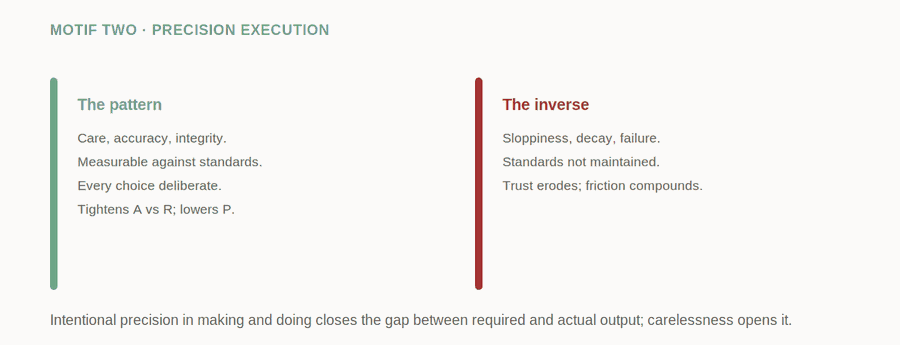
Precision Execution describes intentional precision in the making or doing of anything. It is the commitment to care, accuracy, and structural integrity in every act of creation or work, encompassing both careful attention to detail and the larger concern for overall coherence and quality. It rejects the false choice between functionality and aesthetics, insisting that good work is both useful and excellent, both precise and elegant.
Its core characteristics are measurability, the work can be evaluated against standards, with a right way and a wrong way; intentionality, where every choice is deliberate and the practitioner knows why this approach, this dimension, this technique; and respect for constraints, working with the nature of things rather than against them, understanding that limitations often produce better work than unlimited freedom. The pattern operates by establishing standards and creating cultures of excellence: when it is present, sloppiness becomes visible and unacceptable, quality becomes a shared value, and the mechanism is self-reinforcing, since good work inspires good work.
In TSoT terms, Precision Execution directly affects Actual Output and Required Output. Sloppy execution creates a gap between what is required and what is delivered, and it also affects Problems, since careless work generates downstream complications that compound over time; the formula is far easier to satisfy when execution is precise. When the motif is absent, systems decay, products fail, processes break down, and trust erodes because people learn that standards are not maintained and that care cannot be assumed. The human cost is significant: sloppy work in any domain generates friction that compounds.
Motif Three: Generative Distribution
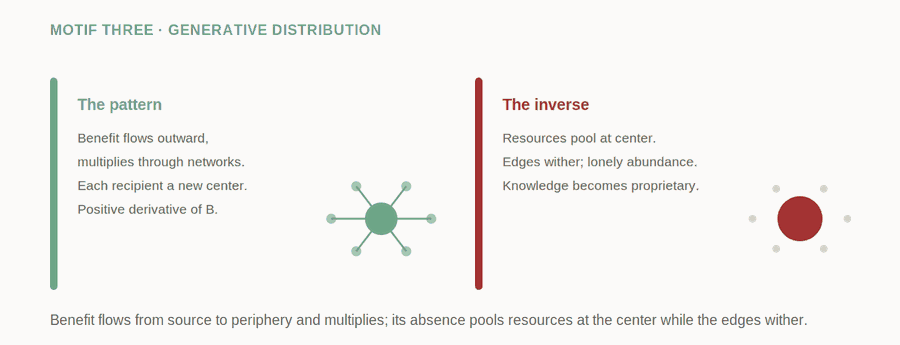
Generative Distribution describes the outward flow of benefit from a source. It is multiplication that moves away from center toward periphery, overflow that reaches beyond original boundaries, generative capacity that does not remain enclosed but spreads. The pattern appears whenever good things received are not hoarded but shared, whenever growth is distribution rather than consolidation, whenever fullness naturally seeks to fill what is empty.
It requires a source with genuine fullness, an actual capacity to share rather than a performance of generosity from emptiness; centrifugal movement, flow from inside to outside, core to periphery, self to other; and multiplication, where each recipient becomes a new center capable of further distribution. The pattern operates by creating circuits of benefit rather than dead ends of accumulation: resources circulate, knowledge spreads, capability multiplies, and the mechanism is networked rather than hierarchical. A mentor who creates other mentors; a profitable division that invests in developing others; a successful product that funds the research for future products.
In TSoT terms, Generative Distribution affects the sustainability of Benefits over time. A system that consolidates benefits at the center may show high benefits in the short term, but the derivative of value is negative, benefits are not multiplying through the system. A system designed for generative distribution may show more modest immediate benefits while the derivative stays positive and benefits compound. When the motif is absent, resources pool at the center and the edges wither: knowledge becomes proprietary, opportunity becomes hereditary, and on an individual level it creates lonely abundance, people surrounded by good things but isolated, having structured their work for protection rather than connection.
Motif Four: Coherence Restoration
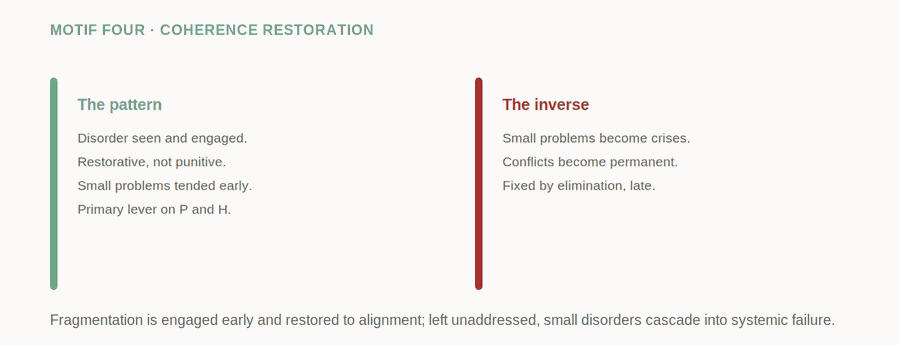
Coherence Restoration describes the work of bringing fragmented, disordered, or chaotic elements back into alignment and wholeness. It is not the violent suppression of difference but the patient work of healing what is broken and ordering what has fallen into entropy. The motif recognizes that disorder is not merely the absence of order but an active force that must be engaged, while insisting that the engagement be restorative rather than destructive, aimed at healing rather than domination.
It requires recognition of disorder, actually seeing what is fragmented rather than looking away; active engagement, taking responsibility to address disorder rather than waiting for it to resolve itself; and restorative intent, an intervention that brings separated parts back into relationship and helps confused elements find their proper place. The pattern operates by creating capacity for repair and resilience: problems are addressed before they cascade, conflicts are engaged before they become permanent rifts, and small disorders are tended before they become systemic failures. The mechanism is both preventive and corrective.
In TSoT terms, Coherence Restoration is the primary mechanism for reducing Problems and Harm. Problems left unaddressed compound, and small harms become large ones; ideality is far easier to satisfy when problems are engaged early and restored to coherence before they multiply. When the motif is absent, small problems become large crises, conflicts that could have been resolved become permanent breaks, and cultures emerge where problems are acknowledged only when catastrophic, then addressed through elimination rather than restoration.
Motif Five: Constitutive Communication
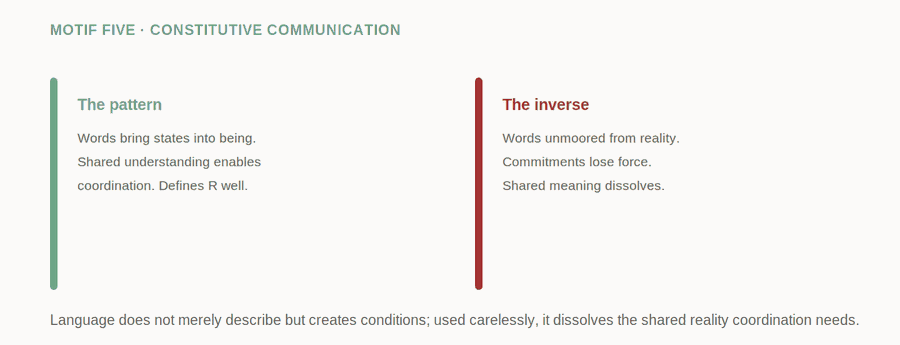
Constitutive Communication describes the power of words not merely to describe existing states but to bring new states into being. It recognizes that language is performative and constitutive, that speaking can alter what is real, that words create conditions. This is not magical thinking but observation: human communication has genuine causal power in social, psychological, and organizational domains. A commitment creates obligation. A diagnosis frames treatment. A vision statement shapes strategy. Words matter not just as carriers of information but as forces that structure reality.
It depends on intentionality, speech directed toward creating specific effects rather than merely expressing feeling; authority, where the speaker has standing to make the speech act, whether from role, relationship, expertise, or earned credibility; and effectiveness, where the words actually accomplish what they set out to do. The pattern operates by establishing what is possible and thinkable: used carefully and truthfully, language creates shared understanding that enables coordination; used manipulatively or carelessly, it creates confusion that prevents collective action. Over time a linguistic framework emerges that shapes what people can imagine, and therefore what they can do.
In TSoT terms, Constitutive Communication affects how Value and Benefits are defined and perceived. The same objective output can be framed as success or failure depending on language, and more importantly, language shapes what kinds of outputs are even pursued; poorly constituted communication can lead a system to optimize for the wrong things entirely. When the motif is violated, words become unmoored from reality, truth becomes whatever serves immediate interest, commitments lose binding force, and shared meaning dissolves until collective problem-solving becomes impossible because there is no agreed-upon reality to work from.
Motif Six: Environment Design

Environment Design describes the creation of conditions where full presence can dwell. It is the work of preparing environments, whether physical, social, or organizational, to be worthy of and capable of sustaining presence and effective work. The motif recognizes that not all spaces are equal, that some contexts facilitate fullness while others fragment it, and that intentional design creates a capacity for dwelling that careless arrangement cannot support.
It depends on intentionality, a space designed on purpose for specific kinds of presence and activity; coherence, where all elements work together toward the same end rather than fighting each other; and hospitality, where the space welcomes and sustains rather than excludes or exhausts. The pattern operates by creating conditions for effective work and flourishing: when present, people can show up fully, do their best work, and sustain effort over time. The mechanism is environmental in the broadest sense, physical space affects what is possible, social norms affect what is acceptable, and organizational culture affects what is sustainable.
In TSoT terms, Environment Design affects the relationship between Actual Output and Required Output. Poor environments create friction that reduces actual output below what the same people could produce in well-designed ones, and they also affect Problems, since hostile or fragmented environments generate interpersonal and operational problems that compound. When the motif is absent, people cannot show up fully; spaces demand constant vigilance against threat or discomfort and communicate that presence does not matter, leaving organizations where people have no place they truly belong, only a series of fragmented roles played in indifferent settings.
Motif Seven: Integrated Character
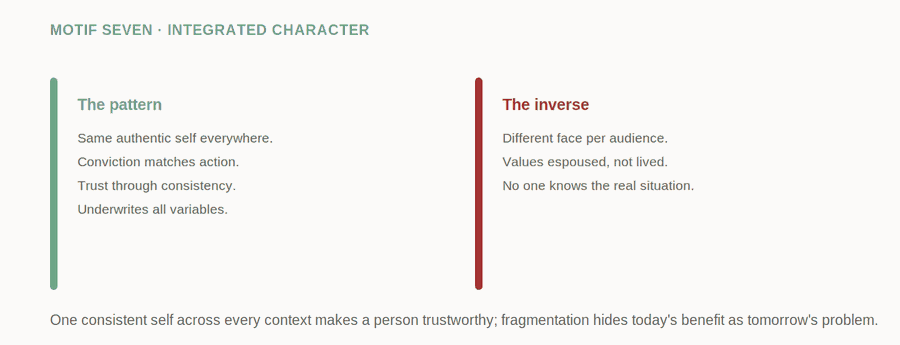
Integrated Character describes the state of being the same authentic self across all contexts and relationships. It is integration of identity such that there is no fragmentation between public and private, professional and personal, what is shown and what is hidden. The motif recognizes that human beings often compartmentalize, presenting different selves in different settings, and proposes that wholeness requires consistency of character regardless of audience or situation.
It depends on consistency across contexts, where values and the way of treating people remain stable even as circumstances change; alignment between conviction and presentation, where what you believe privately is reflected in how you act publicly; and integration of roles, where the various roles you play are held together by a unified self rather than splitting into unrelated personas. The pattern operates at the individual level by creating coherence and reliability: people can trust you because you are consistent, and you need not remember which version of yourself you presented to whom. Maintaining multiple fragmented selves requires enormous energy; integration allows that energy to go toward actual work rather than impression management.
In TSoT terms, Integrated Character affects the sustainability and trustworthiness of all the other variables. A system led by people without integrated character cannot reliably maintain any of the formulas; what appears as high benefit today may be revealed as hidden problems tomorrow when the fragmentation becomes visible. Integrated Character is foundational to the credibility of any system analysis. When it is violated, people become adept at showing different faces to different audiences, espousing values they do not live by, until no one ever knows the real person or the real situation.
The Motifs and the TSoT Variables

Taken together, the Seven Motifs provide operational definition to TSoT's variables. Where the formulas establish the structure of a good solution, the motifs answer the qualitative questions the formulas leave open: not just whether benefits exceed costs, but whether those benefits multiply or stagnate; not just whether output meets requirement, but whether the environment let people produce it.
Read down the mapping and the framework becomes a single instrument. Benefits are defined by Generative Distribution, costs by Precision Execution, problems by Coherence Restoration, harm by Capacity-First Action, actual output by Environment Design, required output by Constitutive Communication, and the trustworthiness of every measurement by Integrated Character. The motifs are not a separate theory bolted onto TSoT; they are the qualitative content of its variables.
The Complete IFR Definition
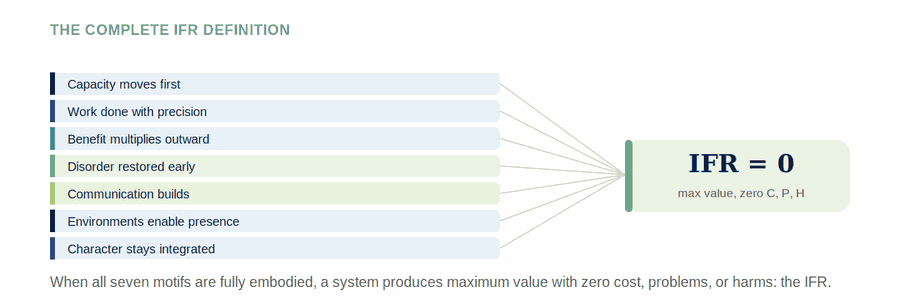
This lets us state the Ideal Final Result qualitatively, as a complement to its mathematical form. A system approaches the Ideal Final Result, IFR equals zero, to the degree that those with capacity consistently move first toward those with need; all work is executed with precision and care; benefits flow outward and multiply through the system; disorder is engaged early and restored to coherence; communication creates shared understanding and positive conditions; environments are designed to enable full presence and effective work; and all actors maintain integrated character across all contexts.
When all seven motifs are fully embodied, the system produces maximum value with zero cost, problems, or harms, the mathematical IFR equals zero. The motifs and the formula describe the same ideal from two directions: one quantitative, one qualitative. The algorithm tells you whether a system has reached its ideal; the motifs tell you what an ideal system is actually made of, and they give the practitioner something to do when the data for the optimal calculation will never arrive. When you cannot know everything, follow these patterns.
Characteristics of Team Systems
By now we can identify a team system, point it toward its ideal with the algorithm, and read where it sits in its own evolution. This chapter gives us the vocabulary to describe what a team system is actually like, its characteristics, and, more importantly, a disciplined way to use those characteristics to find the contradiction worth solving. Characteristics are how the abstract machinery of the framework touches the concrete texture of a real team.
The characteristics discussed here are best thought of as the attributes of a system within the context that has been set, given the particular level of the system under analysis. They are deliberately generic: abstract representations meant to stand in for the specific, contextual characteristics you are actually working to improve in a real organization. The word reliability means something precise in a hospital and something different in a software team, and the generic characteristic is simply the placeholder you fill with your own situation.
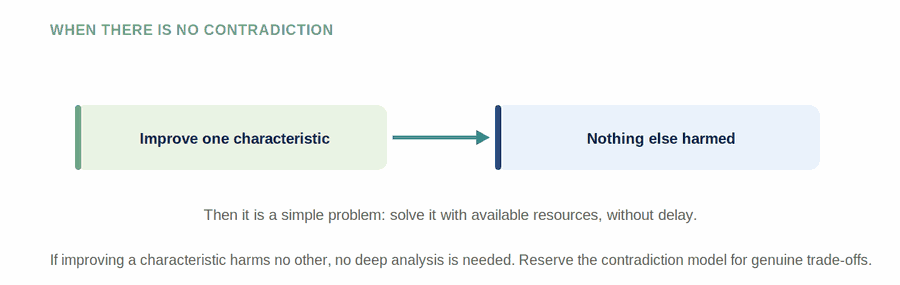
When you are dealing with a specific real-world team, the goal is to align a characteristic you want to improve with a characteristic you want to protect from the negative impact of that improvement. If, in your analysis, you find you can improve a single characteristic without affecting any other, then you are not facing a deep problem at all, and you should solve it with available resources, without delay. The framework earns its keep only where improving one thing genuinely costs another.
Learning Objectives
On completing this chapter, the reader will be able to:
- Use characteristics as abstract stand-ins for the specific attributes of a real team under analysis.
- Apply the characteristic contradiction model: pairing a characteristic to improve with the characteristic most harmed by that improvement.
- Recognize when a problem requires no deep analysis because no other characteristic is impacted.
- Segment a team system into the five characteristic zones for more detailed examination.
- Draw on the sample characteristics as a starting catalog and adapt them to a specific organization.
The Contradiction Model
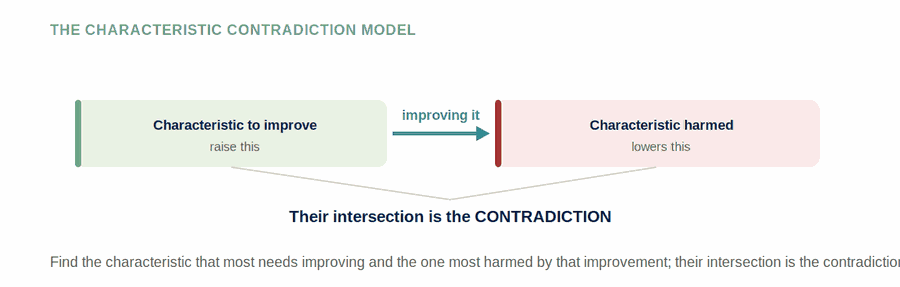
The model for using these characteristics is straightforward to state and demanding to apply. First, identify the characteristic that most prominently needs to be improved to address the problem at hand. Then identify the characteristic that is most negatively impacted by making that improvement. The intersection of those two, the place where getting more of one means getting less of the other, is the contradiction. This is the same notion of contradiction introduced in the framework chapter, now made operational through the language of characteristics.
We will follow a single team through this chapter to keep the model grounded: the inpatient pharmacy of a busy hospital. Its output is correctly prepared and dispensed medication, and almost every characteristic in this chapter applies to it with real stakes. Suppose the pressing problem is that medications reach the wards too slowly. The characteristic that most needs improving is cycle time. But the moment we move to improve it, by simplifying checks, by pushing technicians to work faster, we threaten the characteristics of safety and precision, where in this setting an error is not a defect but a danger. Cycle time against safety is the contradiction, and naming it precisely is most of the work.
It is equally important to recognize the opposite situation. If improving a characteristic harms nothing else, there is no contradiction and no need for elaborate analysis.
If the pharmacy could relabel its storage bins more clearly and thereby improve precision without slowing anything down or costing anything meaningful, that is simply a good idea to implement at once. Spending the contradiction model on it would be wasted effort. The discipline cuts both ways: use the full analysis where trade-offs are real, and move quickly where they are not.
Characteristic Zones
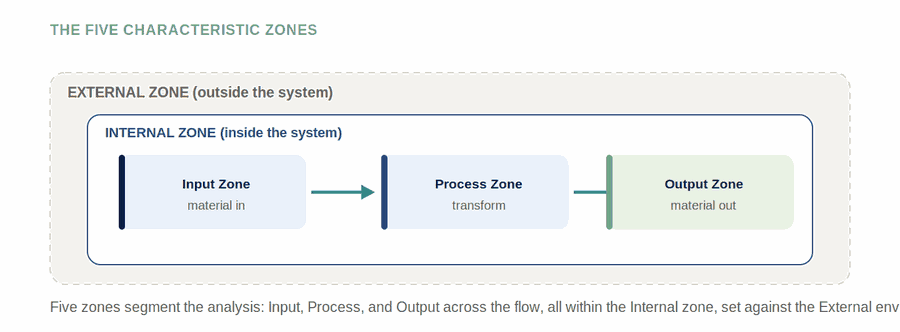
A further guiding principle is the subdivision of team characteristics into zones. The intent throughout is to avoid criticism of individuals and to keep attention on the team as a unit, on its ability to create output, and on its position as a role within a larger system. With that framing, five zones are available for more detailed examination. Like the characteristics themselves, the zones are guiding constructs, not the only valid way to segment an analysis. A zone here is an area with a specific role and characteristic and with well-defined boundaries.
- Input Zone: The roles within the team system that move material input from outside the system to inside it.
- Process Zone: The roles within the team system that internally transform material input into material output.
- Output Zone: The roles within the team system that move material output from inside the system to the external environment.
- Internal Zone: The roles and processes that exist inside the team system.
- External Zone: The roles and processes that exist outside the team system.
In the pharmacy, the input zone is where orders and raw medications arrive; the process zone is where pharmacists and technicians prepare and verify doses; the output zone is where finished medications are released to the wards. The internal zone is the pharmacy itself, and the external zone is everything it depends on and serves, the prescribing physicians, the wards, the suppliers. Locating a problem in a particular zone often sharpens the analysis, because a cycle-time problem in the input zone (orders arriving incomplete) calls for a very different remedy than the same symptom in the process zone (verification bottlenecks).
Sample Characteristics
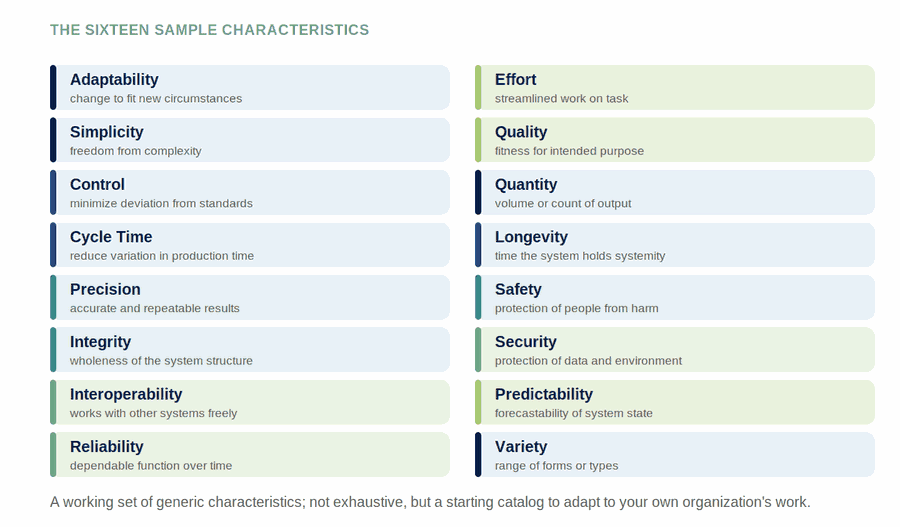
There is no complete list of team characteristics; the varied nature of production, products, and operating environments makes a definitive catalog impossible. What follows is a working set of examples. The important takeaway is the method, not the list: in system analysis, attributes are the tools you use to conceptualize change, identifying the positive attributes to preserve while improving others. A reasonable exercise in your own organization is to begin with these examples and define a tailored set of working attributes that fit the kind of work you do and the focus of your management. Either way, aligning the characteristics of a team to proposed improvements is what enables deep analysis of ideality and value.
Each of these deserves a sentence of grounding. Adaptability is the ability of a system to change itself efficiently and successfully in response to internal or external circumstances; an adaptive system is an open one that adjusts its behavior as its environment or its own parts change. Simplicity is freedom from complexity, intricacy, or unnecessary division into parts, something easy to understand, perform, or explain. Control minimizes deviation from standards and ensures stated goals are met in the intended manner, through setting standards, measuring actual performance, and taking corrective action. Cycle time, treated as a characteristic, is the discipline of driving down the variation in the time it takes to produce successive units of output, a lean focus on removing the internal variation that breeds workarounds and disruption.
Precision combines accuracy and repeatability: measurements fall as close as possible to the true desired value, and the system reproduces that closeness consistently. Integrity, in the TSoT sense, refers to the wholeness and soundness of the system's structure rather than to honesty, though ethical integrity is of course assumed. Interoperability describes a system whose ability to accept input and produce output is so well understood that it can work with other or different systems, now or in the future, without major restriction. Reliability emphasizes dependability across the lifecycle of systemity: the ability to function under stated conditions for a specified period and produce the expected results, closely tied to the availability of both the team and its output.
Effort is the work necessary to convert inputs into outputs, with an implied sense of being streamlined and consistent; in TSoT terms it means work performed at a high rate of professional precision on task, not resources consumed by superfluous activity. Quality is fitness for the intended purpose while satisfying expectations, whether measured as conformance, as production by the correct process, or as the reliability and maintainability of the output. Quantity is the amount or count of an output or role. Longevity is the typical span of time a role or system can hold its systemity. Safety is the condition of being protected from harm, including the control of recognized hazards to an acceptable level of risk, and in TSoT it points specifically at people. Security points instead at data, ideas, products, and environments. Predictability is the degree to which the state, inputs, processes, or outputs of a system can be correctly forecast. And variety is the quality of having different forms or types.
Characteristics in Tension
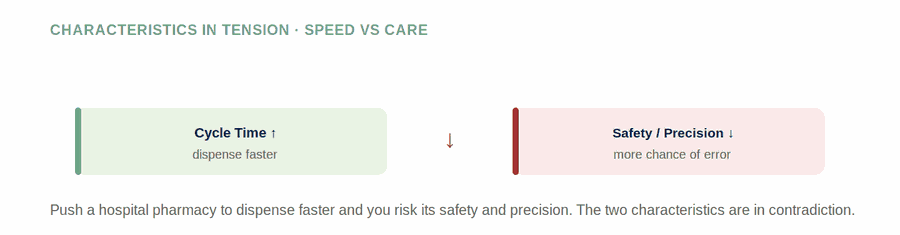
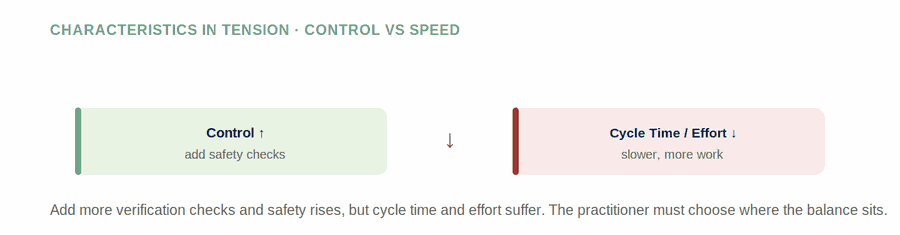
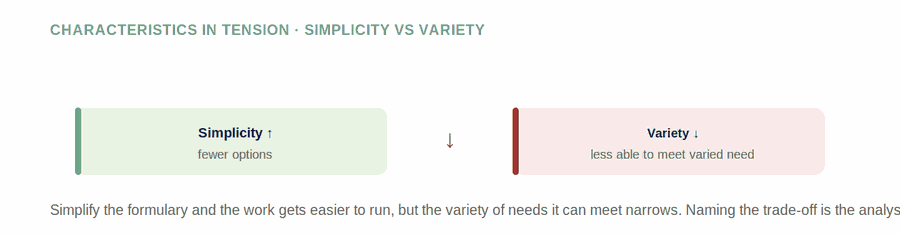
The catalog is only the raw material; the chapter's real lesson is what happens when characteristics collide. Almost every meaningful improvement to a real team system pits one characteristic against another, and the practitioner's craft is in naming the collision precisely and choosing where the balance should sit. Three tensions from our pharmacy make the pattern vivid.
The first is speed against care. Push the pharmacy to dispense faster, raising cycle time as a characteristic, and you directly threaten its safety and precision.
The second is control against speed. Add more verification checks to protect safety, and control rises, but cycle time and effort both suffer as each dose now passes through more hands.
The third is simplicity against variety. Narrow the formulary to a smaller, standardized set of medications and the pharmacy becomes simpler to run and easier to keep safe, but its variety, its ability to meet the full range of clinical needs, contracts.
None of these tensions has a universally correct resolution. In a pediatric oncology pharmacy, safety and precision will rightly dominate cycle time; in a high-volume outpatient dispensary, the balance may legitimately shift. What the characteristics give the practitioner is not the answer but the ability to state the question exactly: which characteristic are we improving, which are we willing to spend to do it, and is that trade the right one in this context? That precise statement is the contradiction, and with it named, the solution models from the catalog become candidate moves for resolving it.
Solution Analysis
This is the chapter where the framework becomes a practice. Everything built so far, the team system and its core, the framework's concepts, the algorithm, the patterns of evolution, and the characteristics, converges here into a single disciplined act: taking a real situation and producing a defensible solution. Solution analysis is where seeing turns into deciding, and deciding into doing.
True disruptive change requires a change in thinking, within individuals and within organizations alike, but that shift in thinking can be the key to sustaining the cycle of creative problem solving that keeps a system growing over the long term. A formal solution analysis process matters precisely because so many ideal final results never come to anything: they remain abstract notions, vaguely felt but never clearly stated, and an IFR that is never articulated can never be tested, shared, or built. The discipline of this chapter is, above all, the discipline of making the implicit explicit.
Learning Objectives
On completing this chapter, the reader will be able to:
- Generate a clearly stated IFR through the five-stage process rather than leaving it abstract.
- Apply the three solution tests to drive toward either an IFR of zero or a precisely located delta.
- Translate a delta into the characteristic zone and characteristics it affects.
- Classify a problem by its solution level and judge where TSoT analysis genuinely adds value.
- Assess a system through key performance measures, its core competencies, its position in the supersystem, and its redundancies.
A single example will run through the chapter. Consider a corporate data analytics team inside a large company: a group that gathers data from across the business and turns it into reports and dashboards that other teams use to make decisions. It has measurable performance, a definable place in the larger organization, and plausible overlaps with other teams, which makes it a useful subject for every part of the analysis that follows.
Generating an IFR
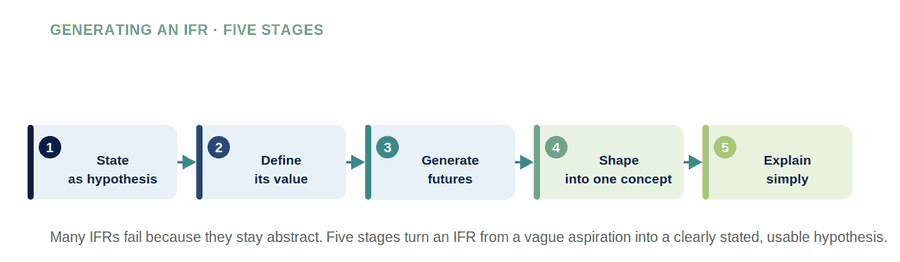
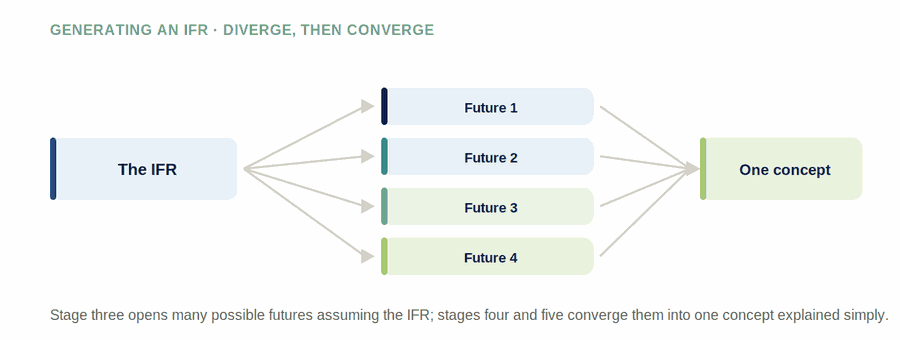
Because the most common failure of an ideal final result is that it stays a vague aspiration, the process begins by forcing the IFR into the open through five stages. The version used here adapts a familiar approach to IFR generation and tunes it to produce a TSoT-style ideal.
- State an IFR as a hypothesis: Commit to a specific, falsifiable statement of the ideal rather than a feeling.
- Define the value addressed: Name precisely what value this new IFR delivers and to whom.
- Generate different possible futures: Imagine several distinct futures that could exist assuming the IFR.
- Shape these futures into a single concept: Converge the explorations into one coherent idea.
- Develop language to explain it simply: Reduce the concept to the simplest possible explanation.
The middle of this process is where its power lies. Stage three deliberately opens the aperture, generating many possible futures rather than settling on the first, and stages four and five close it again, converging those futures into a single concept and then into language plain enough to carry. This diverge-then-converge rhythm is what separates a genuine IFR from a hunch.
For our analytics team, the abstract wish, decisions should be better informed, is not yet an IFR. Pushed through the five stages it might become a stated hypothesis: that every team in the company could have the exact data it needs at the moment it decides, with no separate request and no waiting. That is specific enough to test, and developing a disruptive mindset, learning to think in these terms as an individual, is what lets a practitioner build systems that function in constantly changing markets across every part of the value chain.
The Three Solution Tests
With a stated IFR in hand, the analysis runs the three tests. They are the same tests introduced with the algorithm, now turned outward to feed solution analysis: each test either confirms a part of the system worth protecting or produces a delta that points to specific zones and characteristics.
Test One
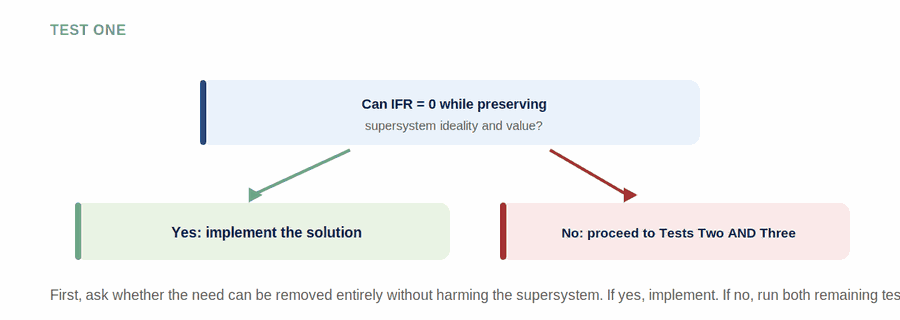
The first test asks whether the IFR can equal zero while still maintaining the ideality and value of the supersystem. If the answer is yes, the best solution is to proceed and implement it. If no, the analysis proceeds to Tests Two and Three together.
For the analytics team, Test One asks whether the need for a separate analytics team could be removed entirely without harming the company, perhaps if self-service tools let every team answer its own questions, while the company's overall ideality and value held. If that is genuinely achievable, it is the strongest solution. If not, the analysis continues.
Test Two: Value

The second test asks whether the current benefits are equal to or greater than the cost of those benefits. If yes, the current benefits and costs remain intact, and the work becomes protective: ensuring no proposed change inadvertently damages them. If no, the analysis identifies the delta needed to bring benefits to or above costs, whether a change to benefit, to cost, or both, and identifies the characteristic zone and the team characteristics that delta will impact, carrying those into the solution analysis.
Test Three: Ideality
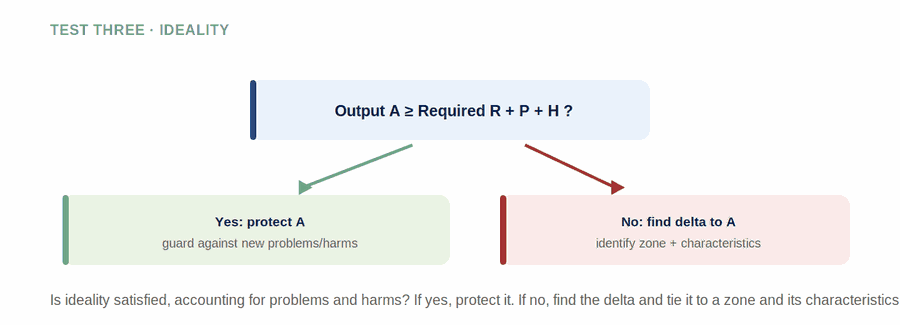
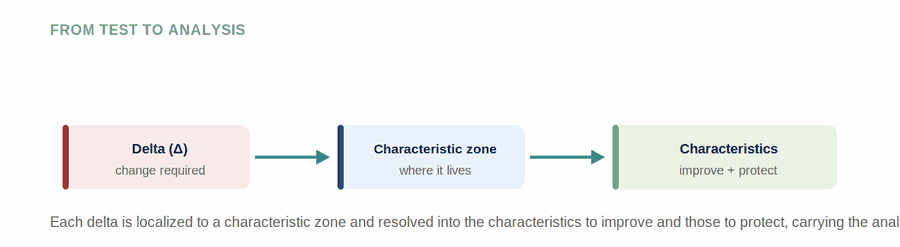
The third test asks whether current output is equal to or greater than required output, accounting for any problems or harms of achieving that required output. If yes, the current output remains intact and must be protected against any change that would reduce it or introduce new problems or harms. If no, the analysis identifies the delta needed to bring output to or above the required level, again accounting for problems and harms, and again locating the zone and characteristics affected.
This is the hinge of the whole chapter: a test that fails does not simply report failure, it produces a delta, and that delta is immediately localized. It belongs to a particular characteristic zone, and it resolves into specific characteristics to improve and others to protect. That localization is what turns an abstract gap into something a practitioner can actually act on.
Solution Leveling
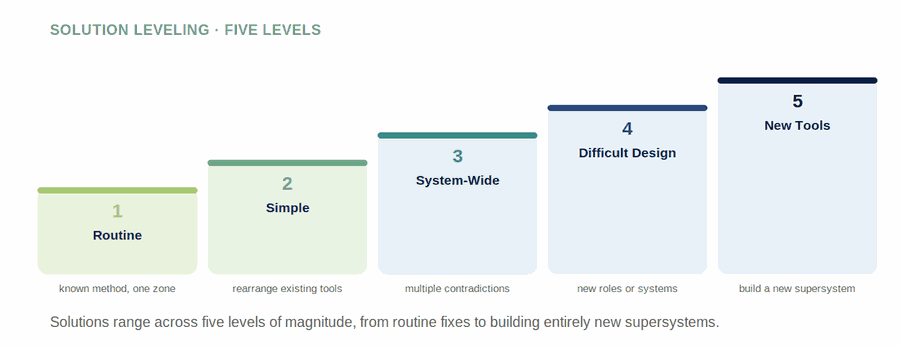
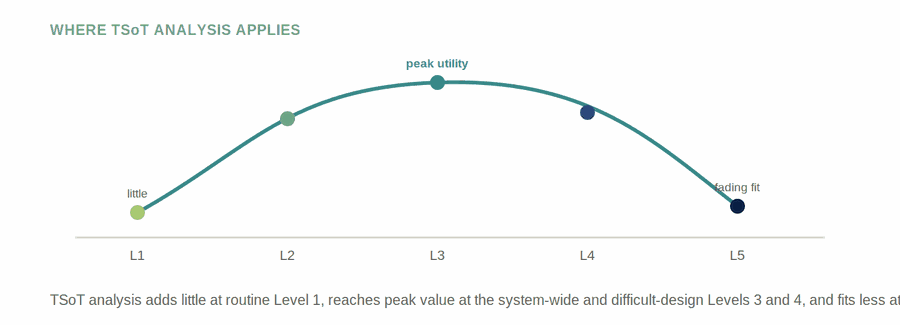

The tests in steps two and three produce a delta: a specific, zone-located change with identified characteristics to improve and to protect. The next step is to analyze that information and develop a proposed solution, and the first judgment to make is one of magnitude. The change required could be small or large, simple or extraordinarily complex, and it is important to conceptualize the order of magnitude needed to bring the system back into balance and to implement the delta with the correct level of impact, neither overbuilding a routine fix nor underestimating a structural one.
There are five levels of solution, and TSoT analysis is neither necessary nor appropriate for all of them.
- Level One: Routine: A straightforward design using one or a few existing roles across one or a few zones, without needing to consider other zones or the supersystem. Routine problems solved by routine methods well known within a specialty; little or no TSoT analysis is needed.
- Level Two: Simple: A minor improvement to an already well-functioning team, rearranging existing tools and choosing one known solution among several. TSoT helps here if you suspect a more innovative approach exists or that broader considerations are blocking larger opportunities.
- Level Three: System-Wide Contradiction: Fundamental improvements to multiple team systems using methods outside a single team's control, where multiple conflicting viewpoints exist. TSoT analysis provides the additional viewpoints that let all parties understand the options.
- Level Four: Difficult System Design: New roles for primary functions, new team systems or substantial new supersystems, or the complete modification of a role, system, or supersystem. TSoT shifts here from a direct solutions framework to an opportunity-identification toolkit.
- Level Five: Requiring New Tools: The development of a completely new, complex supersystem using tools that do not yet exist. TSoT can contribute to concept development but may not be a strong fit unless it helps move from technical to strategic and directional thinking.
Knowing the level tells you not only how large the effort is, but whether this framework is even the right instrument. TSoT analysis adds little to a Level One fix that a specialist already knows how to make, reaches its peak value at the system-wide contradictions of Level Three and the difficult designs of Level Four, and begins to lose its fit at Level Five, where the work is less about resolving team-system contradictions and more about inventing new technology.
There is a deeper point underneath the leveling. In most situations involving contradictions, the typical approach is to weigh positives against negatives and choose the action with the best net result, a trade-off that improves one part of a system while accepting harm to another. The use of the solution algorithm and the solution models within TSoT aims at something different: to resolve the contradiction itself, so that the overall system advances rather than merely shifting its problems around.
An expert TSoT analyst is capable of abstract, imaginative, and analytical thinking, and of applying logic grounded in real knowledge. The consistent use of these concepts and steps yields better control of one's own mental processes and an increasingly strong methodology for developing team-system solutions, built up through experience and practice.
Key Performance Measures
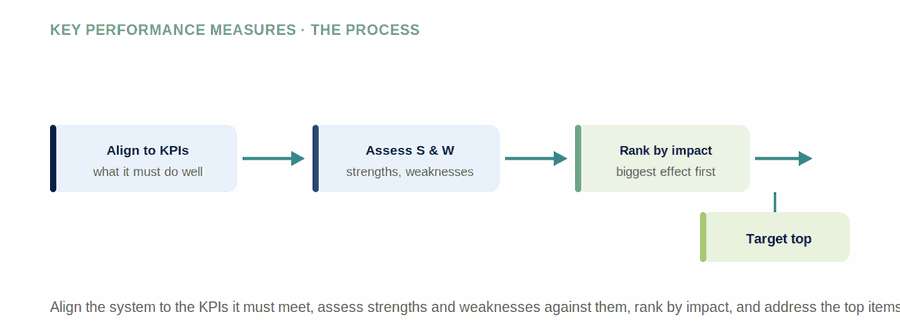
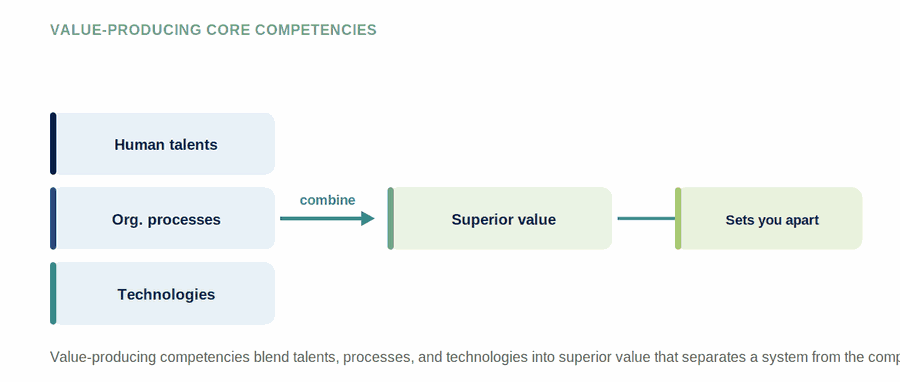
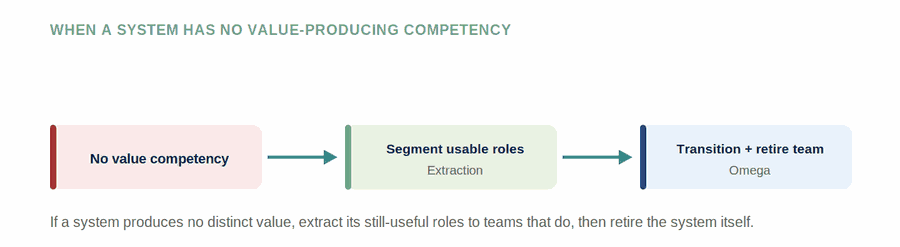
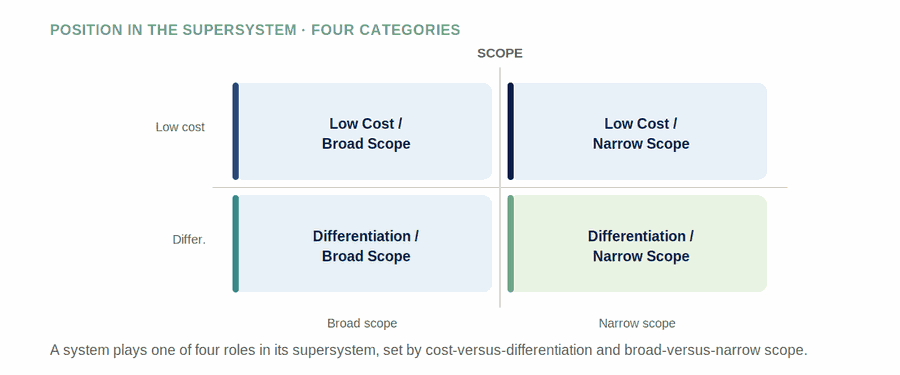
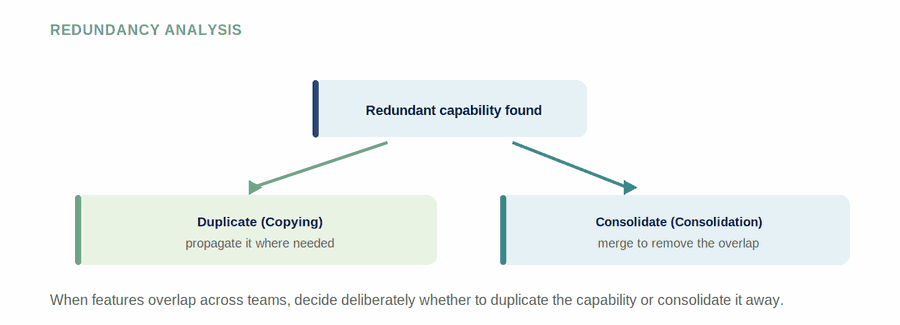
The final part of solution analysis grounds everything in measurable performance. The method begins by aligning the system's function to the existing organization-level or system-level key performance indicators, the things it must do well to succeed, and then uses those indicators as the framework for a strengths and weaknesses assessment.
After assessing strengths and weaknesses, compile them into one or two finalized lists and rate each by how much it contributes to or detracts from the system's success. Place the items with the most significant effect at the top and order the rest down to those with only minor impact. This ranking determines which strengths and weaknesses matter most when strategic objectives are set later: you will work to further enhance the highest-impact strengths and to address the most damaging weaknesses first, working down the list over time.
A central question in this assessment is what the system's unique value-producing features are. Features that create value are a blend of human talents, organizational processes, and technologies combined in ways that deliver superior value. These value-producing core competencies are the aspects of a team system that let it add value to its output and separate it from the competition.
Assess where these features sit within the supersystem's processing cycle and how many consumers, other team systems or end consumers, benefit from them. Many systems that go through this exercise discover they hold no value-producing competencies at all. When that is the case, the honest move is to look hard at segmenting the still-usable roles out of the system, transitioning them to teams that do have value-producing features, and then removing the examined system from the environment.
The next question is where the system fits within a higher-order supersystem. There are generally four categories, and the analysis identifies which role the system is playing.
- Low Cost / Broad Scope: Low-cost features or processing offered to a broad, varied set of supersystems, producing highly standardized, generically appealing output through efficient processes and the lowest-cost relationships.
- Differentiation / Broad Scope: Attributes so unique to several supersystems that the team becomes a key, highly visible processing unit able to drive broad change.
- Low Cost / Narrow Scope: Low-cost features applied to a limited segment of supersystems, serving a narrow slice that behaves differently from the broader base.
- Differentiation / Narrow Scope: Differentiation aimed at a focused set of features, concentrating on a limited set of attributes or roles and differentiating them further than peer teams.
Determining which strategy a system adopts shapes the scope and direction of the analysis itself. The narrower the focus, the more the team can concern itself only with its own features; the broader the scope, the more supersystem components must be analyzed and understood. Our analytics team, for instance, might begin as Differentiation / Narrow Scope, prized by a few departments for a specialized capability, and the question becomes whether it should broaden that scope or deepen its differentiation.
The last element is redundancy. Identify the features of the team under examination and search for redundant capabilities across the most accessible other team systems. Part of defining a solution model is understanding how the system sits within a larger continuum and deciding, deliberately, whether to create duplicate features or to consolidate redundant ones, the same Copying and Consolidation moves from the solution catalog, now chosen on the evidence of the analysis.
If the analytics team's dashboards turn out to duplicate what a finance reporting team already produces, the redundancy analysis forces the choice: propagate one capability deliberately as the standard, or consolidate the two to remove the overlap. Either way, the decision is now made on evidence rather than by accident, which is the whole purpose of solution analysis.
Example Analysis
The previous chapters built the framework and the analysis process; this one puts them to work. Two worked examples follow, each a compact, real-world situation of the kind that crosses a manager's desk constantly. They are deliberately stripped down, carrying only a little data, both to keep the reasoning visible and to show how much insight the three tests can produce even when the information is thin. Read them as demonstrations of the method in motion rather than as exhaustive case studies.
Example 1
Original Statement
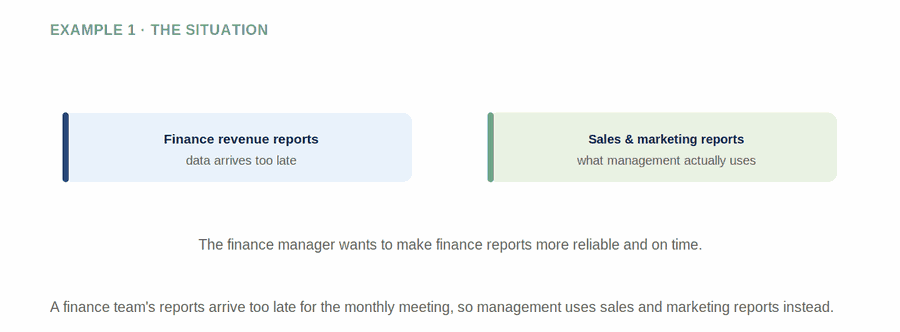
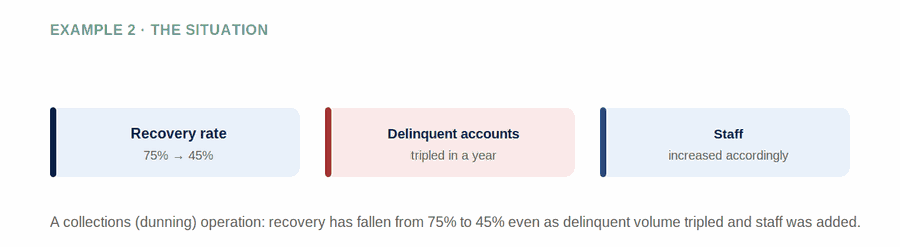
Currently senior management will not use the finance team's revenue reports at their monthly meeting because data shows up too late in the accounting systems to be ready on time; instead they are using the sales and marketing reports. As the manager of the finance data team, I believe we need to figure out a way to improve the reliability of our reports while still having them available on time each month for the review meeting.
Analysis
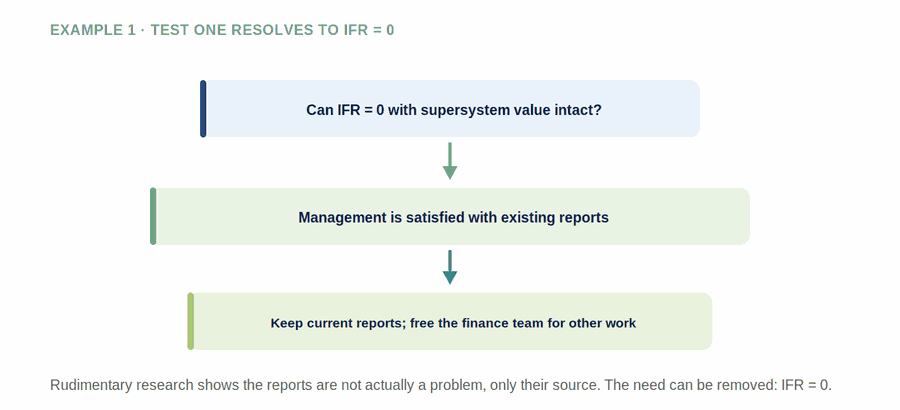
The analysis begins, as always, with Test One: can the IFR equal zero while still maintaining supersystem ideality and value? This is a stripped-down example of a pattern that recurs constantly in the real world under many headings, where a team wishes to exert influence within a supersystem based on its own perception of domain ownership. The finance manager assumes the problem is the finance team's reports. But the supersystem, senior management, is already getting what it needs.
Assuming rudimentary research confirms that senior management is satisfied with the existing reports, and that there is no quantifiable problem with those reports other than their source, which is not a problem at all if the data is correct, this is a case where the IFR can equal zero. In plain terms: continue using the current reports, and free the finance team to work on something that actually adds value.
Example 2
Original Statement
We are struggling with our dunning collection phone calls because of the increased volume of customers going delinquent. Our recovery rates have dropped from 75% to 45% over the past year as the number of delinquent accounts has tripled, even though we have increased staff accordingly.
Test One
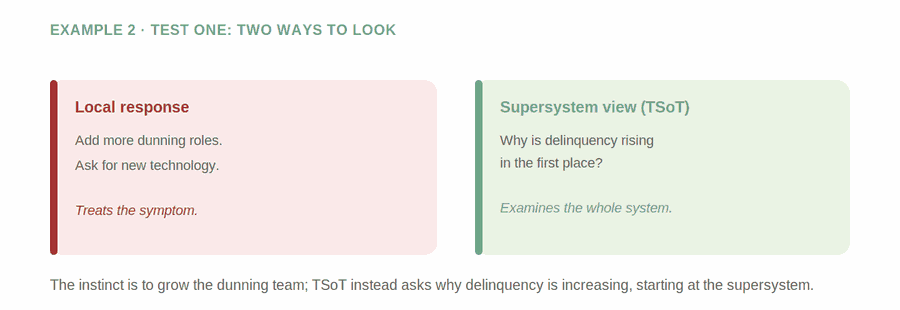
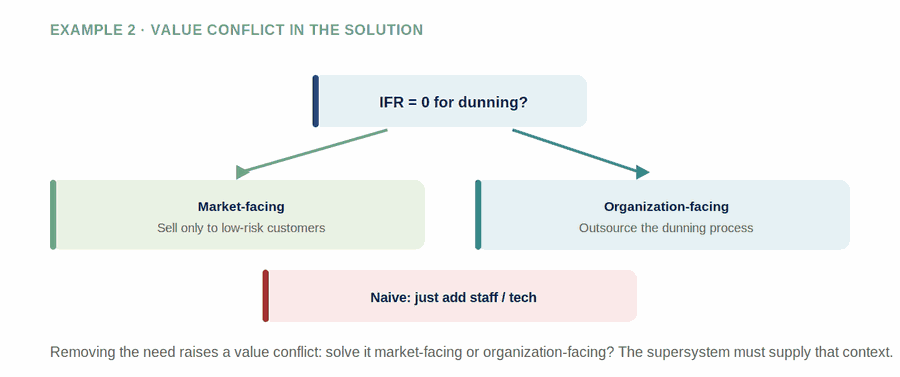
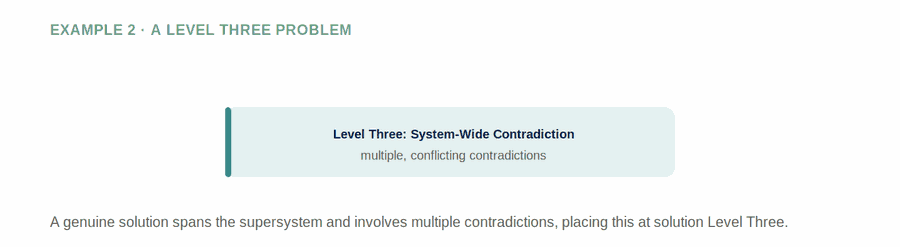
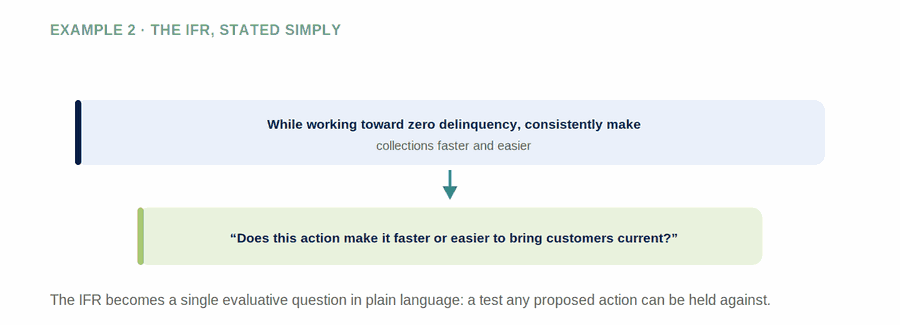
Again the analysis opens by asking whether the IFR can equal zero while maintaining supersystem ideality and value. A typical local-management response would be to add still more dunning roles to the collections team, or to buy new collections technology. TSoT forces a different first move, because it begins with the entire supersystem: it asks why delinquency is increasing in the first place, rather than how to process more of it.
This example also brings the concept of value conflict, defined earlier, into sharp relief. To pursue an IFR of zero for dunning, the supersystem itself must supply direction: do we want the solution to be market-facing or organization-facing? A non-TSoT response focuses on growing the dunning team's capability, asking for more roles or new technology. A TSoT market-facing path toward IFR equals zero might be to sell only to customers who will not go delinquent, or who show the least likelihood of it. A TSoT organization-facing path might be to outsource the dunning process entirely to another organization.
A true solution here is likely multifaceted and spans the supersystem, which makes this a Level Three, multiple-contradiction problem: a system-wide contradiction involving difficult design, process, and team contradictions at once.
For the purpose of illustration, it is reasonable to assume there is no IFR-equals-zero solution available at this stage, meaning there is nothing that can be removed from the system, other than customers, to achieve the ideal. So a stated IFR becomes: while working to reach zero percent customer payment delinquency, we will consistently improve payment collections so they are faster and easier. As an evaluative question, that IFR reads simply: does this action make it faster or easier to bring customers current? Notice the deliberately simple language; it is what makes the IFR usable as a test for every proposed action.
Test Two: Value
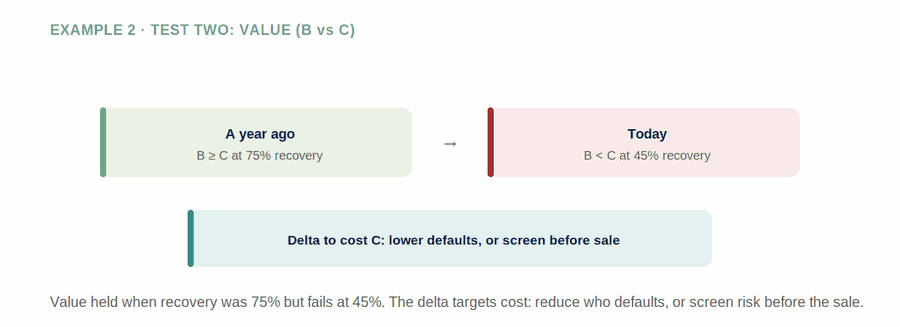
Test two asks whether the current benefits are equal to or greater than the cost of those benefits. We know almost nothing about the actual product, only that it is bought and likely carries some recurring payment structure. But we were given a few metrics, and from them we can reason. Within the past year the number of customers entering the dunning process has tripled, and the recovery rate has declined from 75% to 45%. It is fair to imply that 75% recovery was acceptable while 45% is not, otherwise the problem would have been raised a year ago. We can also infer something about cost: at 75% recovery, dunning costs could scale with sales volume, but at 45% they cannot. Therefore, a year ago, benefits were greater than or equal to cost when recovery was 75%; today, benefits are less than cost at 45%.
At this point one possible delta would be to change the cost C, either lowering it so that fewer customers default and require dunning at all, or deliberately raising it to include some kind of screening check that filters likely defaulters before the sale is ever made.
Test Three: Ideality
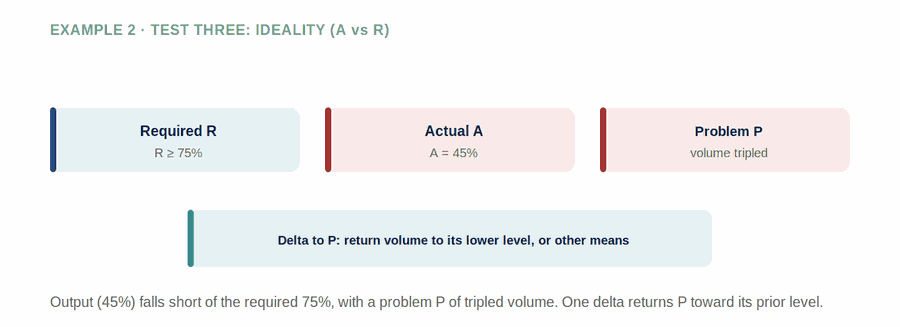
Independent of the value analysis, the data for ideality is presented very straightforwardly. The required output is a dunning recovery rate of at least 75%, so R is greater than or equal to 75%. The current recovery rate is 45%, so A equals 45%. And there is a clear problem, P: the volume of customers entering the dunning process has tripled.
Here one possible delta would be to re-establish the actual output A back to a 75% recovery rate by returning the problem P, the volume entering dunning, back to its lower level, or by some other means. Notice that the two tests, run independently, point at the same underlying issue from different directions: value analysis suggests screening before the sale, and ideality analysis suggests reducing the volume entering dunning. They converge on prevention rather than on processing more collections faster.
Summary
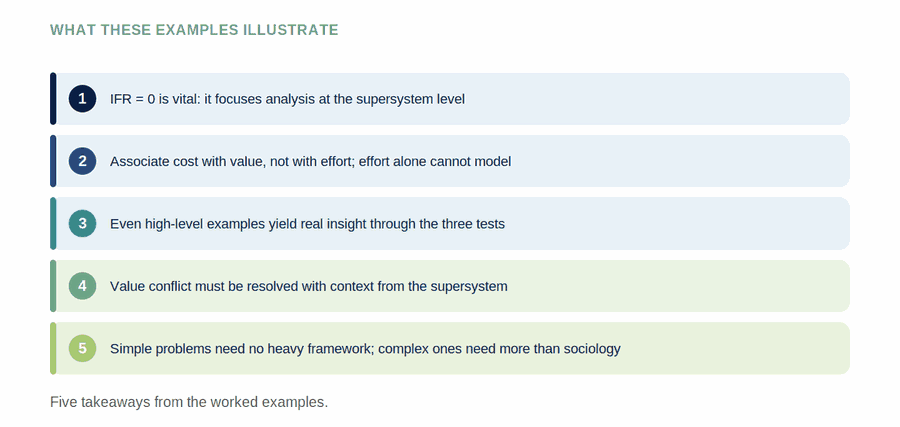
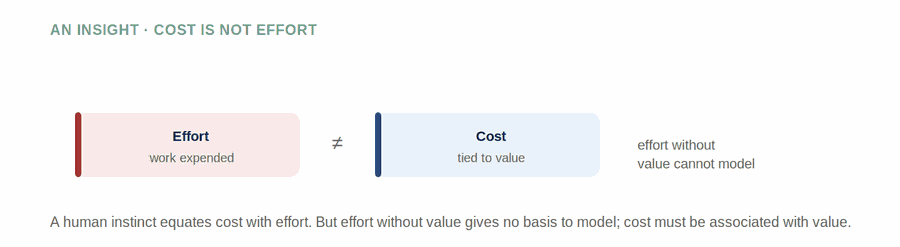
These two examples, deliberately high-level, are meant to illustrate a handful of points about how the framework behaves in practice.
The first and most important is that the concept of IFR equals zero is designed to pull analysis up to the supersystem level, where the real causes usually live, as the dunning example showed by redirecting attention from collections capacity to why delinquency was rising at all. The second is that associating cost with value can be genuinely difficult; a strong human instinct is to associate cost with effort instead, but effort without value provides no basis to model a system properly.
The remaining points follow from the examples taken together. Even these very high-level situations, carrying little additional data, allowed TSoT analysis to produce substantial insight through the three tests alone. Value conflict is real, and it must be resolved as a solution input supplied by the supersystem; without some context, the models themselves cannot answer the question of whether to charge more or to cost less. And finally, the boundary works in both directions: simple problems do not need a complex framework like TSoT to solve, and complex problems do not model well in frameworks based on sociology alone.
The Solution Models
A Pattern Catalog for Transforming Team Systems
Twenty-Five Models
The Solution Models are the working heart of the Science of Teams. Where the earlier chapters establish what a team system is and how to analyze one, the Solution Models supply the catalog of moves available when analysis shows that a team system should change. Each model is a distinct, reusable transformation: a pattern that takes a team system from one configuration to a better one. They are deliberately structural rather than emotional, because the catalog's purpose is to give the practitioner a precise vocabulary of options rather than a single prescription.
No model is universally correct, and several are exact opposites of one another. Segmentation splits a team apart while Consolidation brings teams together; Periodic Action pulses work that Continuity of Useful Action would run without pause. The opposition is the point. The catalog does not tell you which move to make; it ensures that when you face a team-system problem, you are choosing deliberately from the full range of transformations rather than reaching for the one or two you happen to favor.
Each model in this catalog is presented on a single page. The page names the model, presents the transformation as a schematic, a before state, the operation that changes it, and the after state, and then describes what the model does, when it applies, and gives concrete examples with a practitioner cue. Read the description, then let the schematic fix the shape of the move in memory, so that in practice the diagram alone is enough to recall the whole pattern.
Learning Objectives
On completing this catalog, the practitioner will be able to:
- Recognize each of the twenty-five Solution Models as a distinct transformation of a team system, and recall its characteristic before-and-after shape.
- Identify which model or models apply to a given team-system problem, including recognizing when two opposing models are both candidates.
- Distinguish models that are easily confused, such as Segmentation versus Extraction, Consolidation versus Universality, and Periodic Action versus Continuity of Useful Action.
- Apply a chosen model deliberately, anticipating the trade-off it carries, rather than defaulting to a familiar reorganization.
Segmentation (Splitting Up)
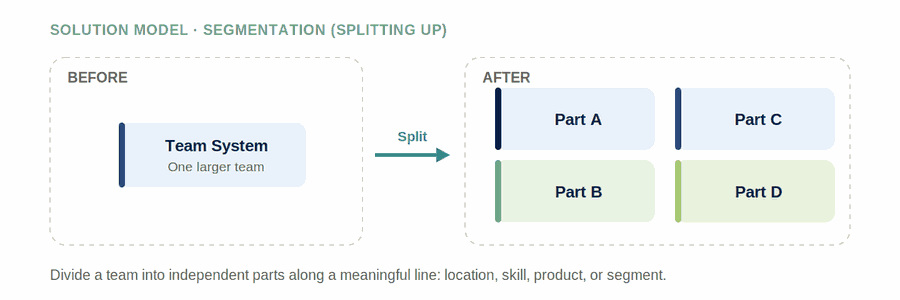
Description
Divide a role or team system into smaller, independent parts along a meaningful characteristic such as location, skill set, product line, customer segment, or any descriptor that genuinely separates the work. Segmentation trades the coordination overhead of one large unit for the focus and autonomy of several smaller ones. It is most powerful when the parts can operate with little dependence on one another, because the independence is what converts size into speed.
Examples
- Replace a single central loan-processing team with a dedicated processing pod embedded at each branch, so approvals happen close to the customer.
- Split a monolithic platform engineering group into product-aligned squads, each owning its own service end to end.
- Carve a regional sales force out of one national team so each region can tune its approach to local demand.
Consolidation (Bring Together)
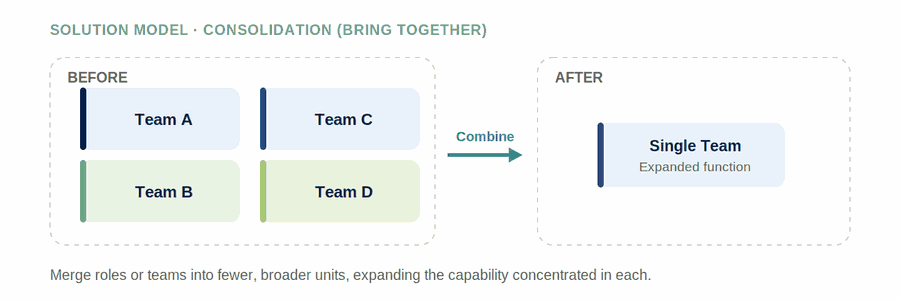
Description
Combine a set of roles or team systems into fewer, broader units, concentrating capability so that each remaining unit does more. Consolidation is the inverse of segmentation: it trades local autonomy for economies of scale, consistency, and the elimination of duplicated effort. It works best when the combined work benefits from shared standards, shared tooling, or a critical mass of expertise that scattered small units cannot sustain.
Examples
- Merge separate per-region server administration teams into one platform operations group managing the whole fleet through shared automation.
- Bring distributed loan officers into a central team that meets customers across all branches over video, raising consistency and utilization.
- Consolidate several small analytics functions into one data team so the organization speaks from a single, governed source of truth.
Extraction
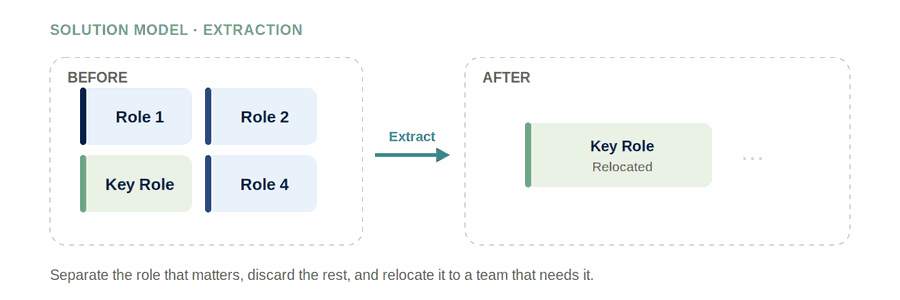
Description
Separate the role that actually matters out of a team system, discard the surrounding elements, and relocate the extracted role to a team that needs it. Extraction is a precision move: rather than reorganizing a whole unit, you identify the single component carrying the value and pull just that, letting the rest dissolve. It is the model to reach for when most of a team is no longer justified but a specific capability inside it is too valuable to lose.
Examples
- Close an underperforming restaurant location but move its head chef, the real draw, to a flagship site while releasing the rest of the staff.
- Shut down a legacy internal tool while extracting its one expert maintainer into the modern platform team.
- Wind down a corporate mailroom but redeploy the two staff who manage secure document chain-of-custody to records management.
Dynamicity
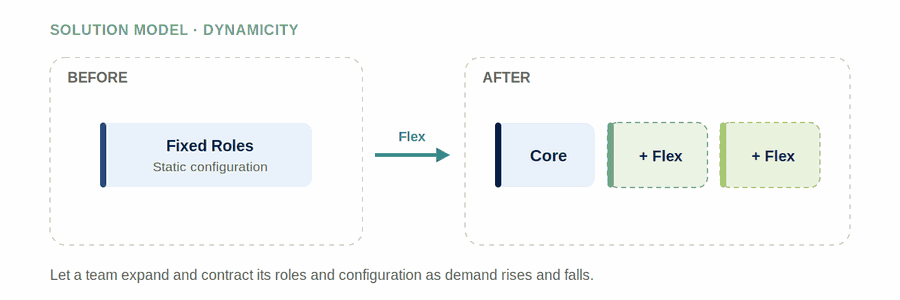
Description
Build a team system whose roles and configuration can change on demand, expanding and contracting as conditions require rather than holding a fixed shape. A dynamic team carries a stable core and a flexible margin that scales up when work surges and recedes when it subsides. Dynamicity suits environments with predictable variability, where a static team would be either overstaffed in the trough or overwhelmed at the peak.
Examples
- A logistics carrier keeps a core driver roster and adds vetted on-demand drivers during seasonal produce and holiday peaks.
- A support organization cross-trains agents so the same people flex between chat, phone, and escalations as volume shifts through the day.
- A venue staffs a stable bar team whose members are also trained and credentialed to work security when an event calls for it.
Local Value / Nonconformity
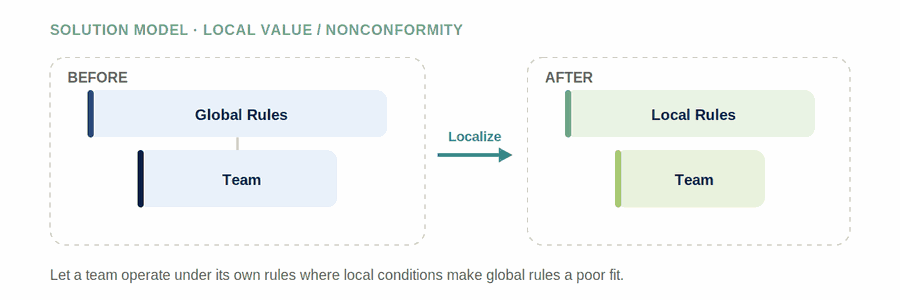
Description
Allow a team system to operate under its own rules, or in deliberate contrast to the prevailing ones, letting value be defined locally rather than dictated by higher-order systems. Local value recognizes that a one-size global rule can be a poor fit for a team whose conditions are genuinely different. The model is a license for justified exception, not a license for chaos: the local rules still exist, they are simply set where the work actually happens.
Examples
- Engineers on an isolated, high-security classified system follow a hardened, air-gapped protocol distinct from the standard corporate development policy.
- Clinicians in an infectious-disease unit hold direct dispensing authority for time-critical treatments that ordinary pharmacy workflow would delay.
- A skunkworks innovation team is exempted from the standard procurement and approval gates so it can move at the speed its mandate requires.
Universality
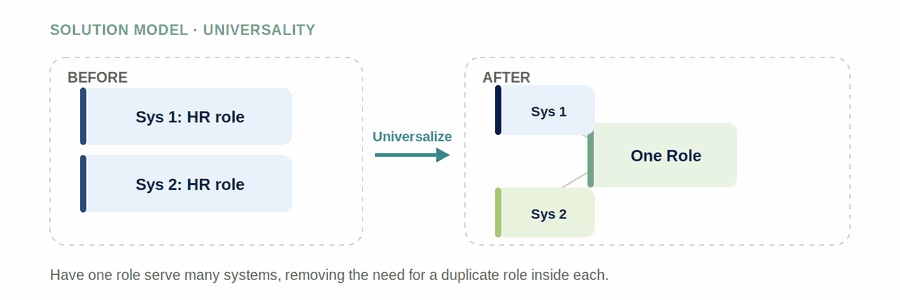
Description
Have a single role perform the same function across multiple team systems, eliminating the need for a duplicate of that role inside each one; equivalently, let one team span several supersystems. Universality removes redundancy by recognizing that a capability needed in many places does not always need a copy in every place. It works when the shared role can serve all its consumers without becoming a bottleneck.
Examples
- One HR business partner supports several departments rather than each department maintaining its own HR specialist.
- A managed-service provider runs the help desk for many client companies at once, spreading a single capability across many supersystems.
- A shared security operations center monitors every business unit instead of each unit standing up its own duplicate function.
Parallelism

Description
If roles or team systems run in sequence when they could run at the same time, change them to operate in parallel; if they are already parallel, increase the parallelism. Parallelism compresses total elapsed time by overlapping work that does not strictly depend on being done in order. The prerequisite is independence: steps can run together only to the degree they do not need each other's output first.
Examples
- An express vehicle service performs billing, tire rotation, and the oil change simultaneously rather than one after another, halving the customer's wait.
- A globally distributed team aligns overlapping working hours so design, review, and testing proceed concurrently instead of handing off across time zones.
- A publishing workflow copy-edits early chapters while later chapters are still being drafted, rather than waiting for the full manuscript.
Recursion
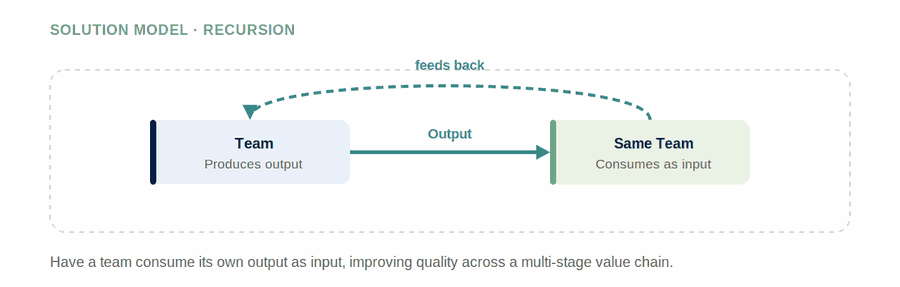
Description
Have a team consume its own output as input, feeding the result of its work back into itself. Recursion is especially useful over short cycles within a value chain, where teams downstream would otherwise receive progressively lower-quality input; closing the loop lets a team refine its own product before passing it on. It concentrates both the production and the immediate quality check in the same hands.
Examples
- Business analysts who produce requirements then consume those same requirements to drive the initial solution design, catching gaps while context is fresh.
- A content team that publishes a piece, reviews its own performance data, and feeds the lessons directly back into the next iteration.
- A line cook who performs the prep for their own shift, so the quality of the input is owned by the person who depends on it.
Prior Action or Counteraction
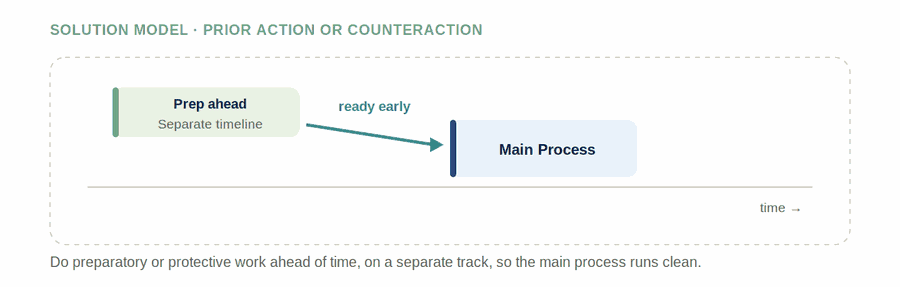
Description
Perform processing before it is needed, on a separate timeline or in a separate environment, or have it carried out by a different team or role. Prior action front-loads work that would otherwise create delay or risk at the critical moment; counteraction pre-empts a known problem before it can occur. Both move effort off the critical path so the main process runs clean.
Examples
- Validate data at the point of capture so that downstream processing never has to stop to clean it.
- Stage and back up a large document set before handing it to another team, so a transfer failure costs nothing.
- Pre-provision environments and credentials the night before a major launch so the launch window is spent shipping, not setting up.
Partial or Excessive Action

Description
When the exact, full measure of a desired process is unachievable or uneconomical, using slightly less or slightly more of the same method can still improve the outcome considerably. The model rejects the trap of all-or-nothing: a partial application that captures most of the value at a fraction of the cost is often the better trade, and occasionally a deliberate overshoot is simpler than precise calibration.
Examples
- Screen a large applicant pool with a short structured phone interview before committing to full onsite interviews, capturing most of the signal at a fraction of the effort.
- Run a deliberately oversized first-come, first-served hiring open house with the manager present, accepting some excess to compress a long sequential process.
- Pilot a change with a partial rollout to one team rather than waiting for a perfect organization-wide launch.
Equipotentiality

Description
When only a few kinds of input can usefully be processed, apply deliberate limiters to the available choices so out-of-bounds variability never enters the system. Equipotentiality tames volatility at the front door: by constraining what can be requested or submitted, it removes whole classes of exception handling downstream. The art is setting the menu wide enough to serve real needs and narrow enough to stay governable.
Examples
- Offer customers a defined menu to order from rather than accepting open-ended requests the kitchen cannot reliably fulfill.
- Route patients through specialty intake so each condition reaches the right specialist instead of an overloaded generalist.
- Constrain a service catalog to supported configurations so the operations team never inherits an unsupportable one-off.
Automated Substitution

Description
Replace a manual process with an automated one, or replace one form of automation with a better one, expanding or contracting the use of technology as the work warrants. Automated substitution moves repeatable, rule-bound effort off people and onto systems, freeing human attention for the judgment-dependent work that remains. The model also runs in reverse: where automation has become brittle or unjustified, simplifying back is itself a valid move.
Examples
- Capture expense receipts by photo and automated extraction instead of collecting paper and re-keying it monthly.
- Record a standard onboarding lecture once for self-paced viewing rather than delivering the same live session every cohort.
- Replace a fragile chain of hand-built scripts with a managed workflow platform that the whole team can maintain.
Change Processing Cycle

Description
Run a process, or specific stages of it, at a different speed or in a different order: faster, slower, reordered, with stages skipped, reversed, or time-boxed, in any combination. Changing the processing cycle treats sequence and tempo as variables rather than givens. Often the work itself is fine and only its rhythm is wrong, and adjusting the cadence unlocks the improvement without touching the substance.
Examples
- When inbound volume rises, process intake several times a day instead of once, so queues never overflow.
- Suspend a seasonal activity entirely in its off-season and intensify it in peak season rather than running it at a flat rate year-round.
- Time-box a stalled review to a fixed window to force a decision instead of letting it expand indefinitely.
Change Feedback or Control

Description
Add new input and output control points within a system, or, where they already exist, increase or decrease their magnitude; likewise add, expand, or reduce non-control data points. This model tunes how tightly a system is governed and how much it sees. More control adds assurance at the cost of friction; less control adds speed at the cost of oversight. The skill is matching the level of control to the actual risk.
Examples
- Introduce a short daily control checkpoint where in-flight work is reviewed and new work is authorized.
- Replace standing daily reviews with a lighter exception-based check-in triggered only at defined decision points.
- Add observability to a process that was running blind, so the team manages by data rather than by anecdote.
Horizontal or Vertical Integration (Change Dimensions)

Description
Change, integrate, consolidate, or relocate roles along the value chain. Vertical integration absorbs steps above or below you in the chain, from supplier toward customer; horizontal integration combines peers operating at the same tier. Both are deep disciplines in their own right and reward separate study, but as a team-system move they are about deciding which parts of the chain you should own directly.
Examples
- Begin producing a component in-house, or acquire the supplier outright, rather than buying it on the open market (vertical).
- Consolidate many regional warehouses into a few larger ones, or distribute one central operation into several (horizontal).
- Bring a previously outsourced capability back in-house when it becomes core to the value you deliver (vertical).
Convert Harm to Benefit (Blessing in Disguise)
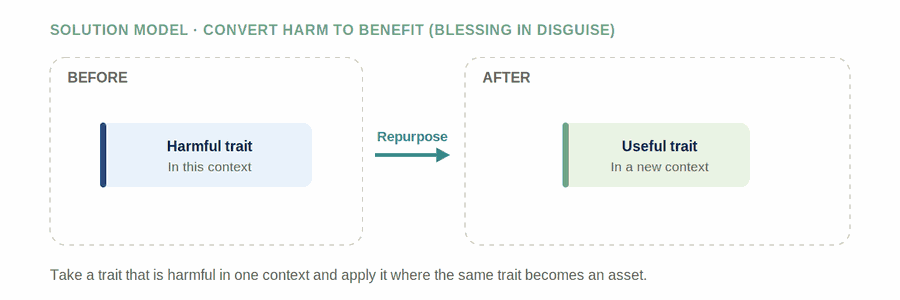
Description
Take a factor that is harmful or problematic in one context and apply it where the same trait becomes an advantage. Convert harm to benefit reframes a liability as a resource by changing the context rather than the trait. The move requires seeing past the label attached to a characteristic to the underlying property, which may be exactly what some other situation needs.
Examples
- Redirect people whose intensity and directness make them poor fit for calm advisory roles into high-pressure coordination roles where that intensity is an asset.
- Use an enforced period of remote operation to finally complete the deep, uninterrupted work that the normal cadence never allowed.
- Turn a noisy, opinionated customer segment into a structured advisory panel whose candor sharpens the product.
Periodic Action

Description
Replace a continuous action with a periodic one, or, where action is already periodic, adjust its intervals and durations, intensifying or relaxing the rhythm over time. Periodic action recognizes that not all work needs to run constantly; pulsing it can lower cost and fatigue while still meeting the need. The inverse adjustment, tuning an existing cadence, matches the pulse to changing demand.
Examples
- Reduce a three-shift continuous operation to two shifts when demand no longer justifies round-the-clock running.
- Increase cleaning from once daily to frequent recurring passes when conditions raise the standard required.
- Move from always-on monitoring alerts to scheduled digest reviews for low-severity signals, reserving real-time alerts for the critical few.
Continuity of Useful Action
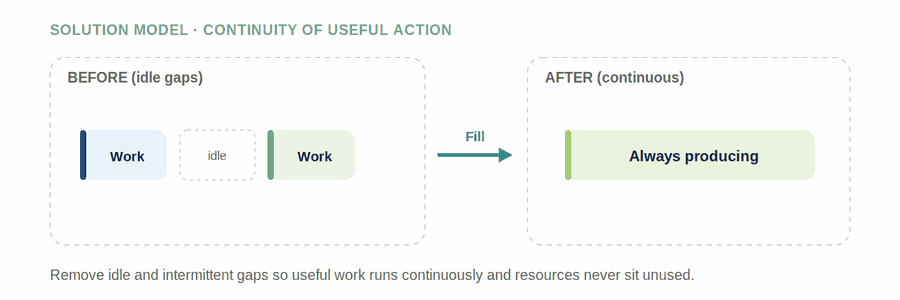
Description
Eliminate idle and intermittent stretches, extend the run of genuinely useful work, and organize the team so the resources available to it are never sitting unused. Continuity of useful action is the complement of periodic action: where the work truly is valuable to run without pause, the goal is to close the gaps so nothing valuable stands idle. It targets the waste of capacity that exists but is not being applied.
Examples
- Move a two-shift operation to three shifts so an expensive facility produces around the clock instead of standing dark overnight.
- Replace recorded-and-rebroadcast content with a continuous live feed that is always delivering value.
- Rebalance work so a specialized, high-cost team is never blocked waiting on upstream input it could be pulling forward.
Intermediary

Description
Insert a go-between system or broker so parties interact through a managed link rather than directly. An intermediary can be a mediating role, a queue that buffers input and output, a transaction manager, or a simple in/out mechanism. It decouples the parties, absorbs timing mismatches, and gives a single place to apply control, at the cost of an added hop.
Examples
- Have an agent negotiate a contract on a performer's behalf instead of the performer dealing with the counterparty directly.
- Buffer incoming and outgoing work through queues so each side processes on its own rhythm rather than in lockstep real time.
- Route cross-team requests through a single intake broker so priorities are managed in one place instead of negotiated ad hoc.
Self-Service

Description
Build the inputs and capability a team needs directly into the team's own processing, so it no longer has to reach outside itself for what it requires. Self-service removes the dependency and the wait that come with relying on an external provider, trading a measure of central control for local speed and ownership. It works when the team can responsibly hold the capability it is given.
Examples
- Let customers order and pay at a self-service terminal rather than queueing for a cashier.
- Give a team a bounded budget and the authority to purchase its own tools directly instead of routing every request through procurement.
- Provide engineers a self-service platform to provision environments on demand rather than filing tickets and waiting.
Temporary
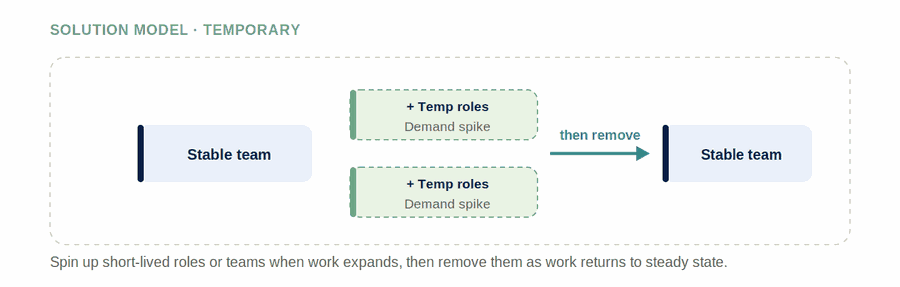
Description
Create roles and teams that exist only for as long as the supersystem needs them, expanding the number of limited-life roles as work grows and removing them as work returns to a stable state. The temporary model treats some capacity as explicitly disposable, avoiding the permanent overhead of staffing for a peak that will pass. Its discipline is in the removal: temporary structures must actually be dismantled, not quietly made permanent.
Examples
- Hire seasonal staff to absorb a holiday retail surge, then return to the steady-state team afterward.
- Stand up a cross-functional project team for a one-time initiative and dissolve it once delivered, returning members to their home roles.
- Form a short-lived incident response team for a specific crisis and stand it down once the situation stabilizes.
Copying or Cloning

Description
Rather than building something new or growing one team to an unwieldy size, create multiple copies of something that already works, placed in the same location or distributed across many. Copying propagates a proven pattern instead of reinventing or over-centralizing it. It favors replication of a known-good unit over the risk of a novel design or the bottleneck of a single oversized one.
Examples
- Stand up identical regional help desks using the same tools and runbooks instead of routing everything through one central desk.
- Replace one large audit group with several smaller, identically structured groups working different domains in parallel.
- Replicate a successful pilot team's exact structure into new markets rather than designing each market's team from scratch.
Change Tools

Description
Change the base tools a role or team uses: swap one technology for another, adopt a different methodology or framework, or move to different standards and practices. Changing tools holds the work constant and improves how it is done. Because tools shape behavior, the right change can shift outcomes without reorganizing people, while the wrong one can disrupt a functioning team for little gain.
Examples
- Adopt a recognized industry standard for a process in place of one developed informally and inconsistently over time.
- Move software delivery from a sequential methodology to an iterative one to shorten feedback loops.
- Replace a sprawling set of point tools with a single integrated platform the whole team can learn once and share.
Change Environment

Description
Move a role or team between environments, up or down a level, and deliberately co-locate, isolate, mix, or separate teams. Changing the environment alters the surroundings the work happens in rather than the work itself, recognizing that proximity, isolation, and the company a team keeps all shape how it performs. The move can raise collaboration or protect focus, depending on which the situation needs.
Examples
- Bring regional field offices into the corporate environment while preserving each one's own dedicated workspace.
- Shift a team from an open bullpen to individual offices to protect deep focus, or the reverse to raise spontaneous collaboration.
- Isolate a security-sensitive team into a controlled environment separate from the general population.
Transform or Change an Attribute

Description
Add different roles to a team or different teams to a supersystem, change the requirements of an existing role or team, or alter the input, processing, or output of a team system. This is the most general model in the catalog: where the others move, split, combine, or re-time existing elements, this one changes the elements themselves. It is the model to reach for when the structure is right but a defining attribute of it is wrong.
Examples
- Add operationally experienced members to an audit team so its findings are grounded in real-world practice.
- Remove a degree requirement from a role to widen the talent pool, or add a specific credential where the work now demands it.
- Change a team's output from a static report to a live, queryable data product that consumers can act on directly.
Strategic Analysis

Solution analysis tells you what to change in a team system; strategic analysis tells you which direction the whole enterprise should be heading so that those changes add up to something. This chapter situates the framework inside the broader discipline of strategy, and it argues for a particular kind of strategy, one built on continuous strategic thinking rather than rigid planning, because that is the only kind that survives contact with a fast-moving market.
Strategic planning is nothing new. Its earliest roots are usually traced to the military tactics of long-gone civilizations, and early merchants applied similar techniques in pursuit of success in their markets. The rise of thriving global markets and information technology has accelerated the evolution of strategic theory, and TSoT adapts its tools for analysts focused on strategic planning for team systems.
As applied to organizations, early strategic planning was often task-based: a rigid list of actions leading to a fixed goal. Those early theories did not incorporate continual assessment of external environments, internal resources and their allocation, or the possible need for quick changes in course. They did not develop the continuous strategic-thinking skills that let a strategist see system issues in the bigger context of interrelated markets and broader supersystems.
That lack of flexibility left organizations unable to compete in rapidly changing markets, because they could not change course quickly enough to keep up. Technology and globalization have produced a marketplace that changes far faster than it did even a generation ago, and techniques that once had a solid success rate now need to be far more flexible and open to rapid change.
Learning Objectives
On completing this chapter, the reader will be able to:
- Contrast rigid task-based planning with continuous strategic thinking, and explain why the latter suits fast-changing markets.
- Describe newer strategy-formation theories, including appreciative inquiry and systems thinking as strategy.
- State the three rationales for strategy and the role of stakeholder buy-in to system IFRs.
- Apply SWOT analysis and the functional-unit and value-tree assessment methods to frame an IFR.
- Use strategic planning tools, scenario building, forecasting, and modeling, and select among the six BPS planning models.
A single example runs through the chapter: a regional grocery chain facing pressure from national competitors and the rise of online delivery. It must decide not just how to fix individual stores but where the whole business should be heading, which is exactly the work of strategic analysis.
Classical theory tended to view strategic planning as the concern of executives and top decision makers alone, on the belief that a micro-focus on technical skill sat at the forefront of industry. That top-down approach worked marginally in some past cases, but it lacks input from the people most aware of how the team systems actually work. In a static environment, those at the top can rely on past experience to find the competitive approach; in a fast-changing environment, a more flexible approach that uses the knowledge of all levels becomes almost essential. As strategic theories have evolved, an emphasis on strategic thinking has emerged, with methods for applying strategic principles not only at the top but across every organizational level. A key of TSoT, stated several times already, is that systems must be defined by IFRs, and those IFRs must link back into higher-order systems defined by a strategic context.
Newer theories emphasize strategic thinking skills over mere planning methods. Both matter, but each alone quickly becomes useless: planning without thinking is empty conceptual theory, and analytical rigor without direction goes nowhere. The skills of strategic thinking blend creative conceptualization with analytical rigor, and as markets grow more complex and decisions harder, those skills are what let managers and workers function amid constant change, creating strategy and implementing action that orients the organization while staying flexible.
Newer Theories of Strategy Formation

Three newer strategy-formation theories illustrate the shift toward strategic thinking and conceptual integration over a purely analytical approach: appreciative inquiry, the executive-evolution approach, and systems thinking as strategy.
Appreciative Inquiry
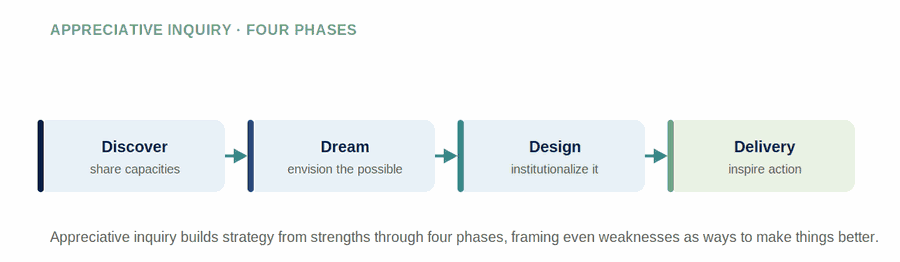
Appreciative inquiry is a qualitative approach to strategy formation that emphasizes discussion and participation. It encourages an organization to focus on the positive aspects of its supersystem, its best practices, rather than on fixing problems. The original approach moves through four phases: discover, collecting and sharing the common and differing capacities of stakeholders; dream, envisioning a better, possible future; design, discussing what must be done and institutionalizing the vision; and delivery, inspiring action. The focus on the positive draws more active engagement from employees at every level, while still addressing weaknesses, which are reframed as ways to make things even better rather than as problems.
For our grocery chain, appreciative inquiry would begin not with the threat from competitors but with what the chain already does best, perhaps deep local relationships and fresh regional produce, and build the strategy outward from those strengths.
Systems Thinking as Strategy

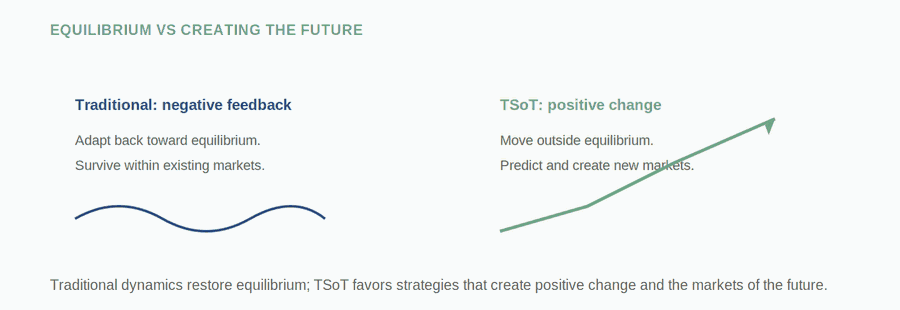
Systems thinking, applied to management, views organizations and markets as an organism or ecosystem of interrelated parts rather than focusing only on specific parts. The complexity of systems was first outlined in organic systems as a way to understand natural and social phenomena, and in recent years it has been applied to management in search of a general systems theory for managers. The debate continues, with proponents calling this wider view the only realistic way to understand a changing market, and traditionalists preferring the simplicity of older theories.
A systems-thinking approach opens the door to applying the scientific method to decision making: forming hypotheses and testing them through experiment closely parallels the continuous application of strategic-thinking skills, assessing the best actions while keeping the flexibility to adjust when something does not work. This differs sharply from traditional management teaching, which stresses individual parts and specific processes. As markets grow more complex, managers increasingly must assess interrelated internal and external environments to formulate workable strategy and adjust it as forces change.
System dynamics has likewise been applied to markets and organizations, studying the flow of feedback and the behaviors it produces. Traditional system-dynamics thinking holds that negative-feedback processes drive successful systems toward equilibrium as they adapt to their environments. Newer theories propose instead that strategies creating positive change, and operating outside equilibrium, yield more competitive results. In management terms: organizations that create unique strategies and positive change, predicting future market trends and capitalizing on them, will outcompete organizations that merely survive by adapting within existing markets.
This mirrors the process of strategic thinking, which requires developing the skill to move from using negative feedback to creating positive change by predicting and creating the future of markets. This, as you can gather, is the approach TSoT advocates.
The Rationale for Strategy

There are several theories about why strategic planning matters, and three important ones each emphasize a different area. The direction rationale holds that strategic planning develops a direction for systems. The future-shaping rationale holds that a plan helps a system shape its own future. The big-picture rationale holds that planning creates the context in which a system operates. All three are true and important, and with the combined skills of strategic planning and strategic thinking, all three can be achieved through the process of strategy formation and execution.
Stakeholder buy-in to the IFRs we identify is another important result of strategic planning. Stakeholders, those with an investment in the systems, including key decision makers and influencers, become committed to the strategy when they are engaged in formulating the system-level IFRs. They also contribute insights, macro-level knowledge of the system, and ideas that might otherwise have been missed, and implementing system strategy within the supersystem helps these factors function beyond the system itself, improving competitive position in the marketplace.
The Steps of Strategic Thinking

There are many views on what strategic thinking is and how it should be implemented across organizational levels. What were once process- and task-oriented planning methods have developed into a thought process called strategic thinking, which combines creative and analytical skills to help managers ask questions, create ideas, and implement methods that produce new value, both in the organization and in the larger business ecosystem. These skills require assessing competition, organizational resources, and market trends by analyzing patterns and relationships, in order to gain the foresight to develop unique plans and solutions.
Continuous strategic thinking, coupled with effective planning, produces organizations that create new value and retain the flexibility to reallocate resources and strategy rather than clinging to predetermined plans that quickly go stale. It lets an organization respond to change as, or even before, it occurs. In the current economy it is no longer efficient to change only once backed into a corner; remaining competitive means predicting future trends and consumer needs and implementing plans that help create that future. Strategic management is no longer about fixing problems as they arise but about determining issues before they arise and implementing solutions to avoid them. With practice, the steps that follow stop being sequential and begin to happen simultaneously, continuously, and cyclically.
Traditional business strategy teaches an organization to take a position in a market and then defend it within market forces, making the organization a stone in a river of those forces. The newer view is that organizations and the people in them should develop the skills to be the river instead of the stone.
Developing these skills means getting comfortable with change and learning to assess trends and patterns in complex, shifting situations well enough to extract what matters for the decision at hand. Strategic thinking is the ability to think in a big-picture context, gather and analyze data, and implement solutions from that data while changing methods as often as necessary. Adaptation and change should be a natural part of doing business rather than an occasional surprise.
Framing the IFR with SWOT


A useful starting question is what strengths, weaknesses, opportunities, and threats currently surround the system under analysis. A SWOT analysis provides exactly this: strengths and weaknesses focus on the internals of the system, while opportunities and threats focus on the environment it sits in. A good analyst prepares a SWOT, even briefly, and uses it to frame the boundaries for the IFR.
When assessing strengths and weaknesses, it helps to choose an assessment methodology suited to the particular system. Two are worth naming. The functional-unit method examines the system as a series of separate functions, each feeding one quadrant of the SWOT; when looking at supersystems, it watches for duplicated functionality across as broad an environment as possible. The value-tree method instead assesses the system's value-producing processes, support functions, input, conversion, and output processes, as collective wholes, grouping functions into tree branches and assessing each branch together.
Linking the IFR to future trends draws together the skills of strategic thinking, the methods of strategic planning, and good leadership, encouraging these skills throughout an organization. The need for analysts who can do this is becoming inherent to organizational survival, and the responsibility increasingly falls to managers, not only executives, who implement strategy by prioritizing and allocating resources so that every area aligns with the larger strategic vision.
Tools for Strategic Planning


There are many planning methods, with more appearing constantly, and all rely on the foresight and analysis inherent in strategic thinking. They help planners create and test strategy that orients the organization so it can withstand change and respond with well-considered solutions rather than short-term fixes. It is impossible to foresee every consequence, but the right tools let you assess, as well as possible, whether an implementation will have the desired effect.
Scenario building shows the possible consequences of a strategy by designing a hypothetical situation in which planners can assess implications without real-world risk; it is essentially modeling the effect of a single change, long standard in science and just as applicable in business. Forecasting predicts future events from historical data and is tied to the strategic skill of analyzing relationships, trends, and patterns; where traditional theory changes only to restore equilibrium, forecasting adds foresight, helping an organization avoid being surprised by disruption and gaining the advantage of being a step ahead with solutions ready. Forecasts can be grouped into what will probably happen, what might happen, and what probably will not happen but is possible; being intellectually prepared for each makes any of them easier to handle.
Modeling and simulation extend scenario building with a range of techniques for representing a process or problem to predict behavior or find solutions. Graphical or qualitative models represent problems in conceptual terms, flows, resources, information, causal or relational structures, and require clear identification of concepts, relationships, and interactions. Quantitative models represent the problem mathematically so interactions or outputs can be calculated, and additionally require a basis for those calculations. Models that account for feedback between parts of a system are called system-dynamics models, and though usually complex, they reveal dynamic interactions other techniques miss. The simplest modeling, it is worth remembering, needs nothing more than a sheet of paper and a pen.
BPS Strategic Models
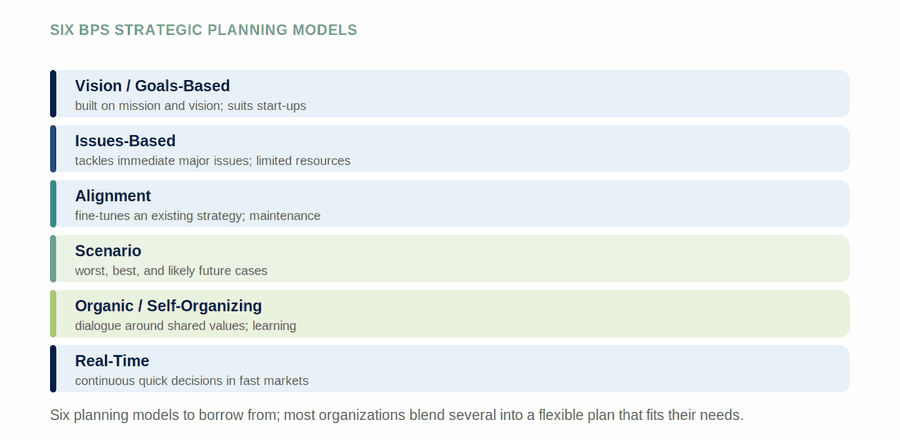
Strategic modeling is by nature future-oriented, and it is an important part of shaping the future of a business ecosystem and establishing a unique position within markets. A strategic plan also orients daily operations toward larger objectives and frames the prioritization of everyday tasks and decisions. The six models below have each been applied to strategic planning in different ways; the appropriate choice fluctuates with an organization's services, size, and resources, and the models are best treated as hypothetical starting points to be adjusted and combined.
Each model has a natural home. Vision- or goals-based planning builds the plan around an organization's mission and vision, identifying the goals and actions that keep it aligned with that future; it suits start-ups and organizations with ample resources and time. Issues-based planning starts from the most immediate major issues an organization faces and centers on the objectives and actions to address them; it suits organizations with limited planning resources. The alignment model fine-tunes an existing strategy rather than overhauling it, outlining mission, programs, resources, and needed support, then adjusting what is not working. Scenario planning assesses the future consequences of strategy by imagining worst-, best-, and reasonable-case futures, leaning heavily on trend analysis and substantial data. Organic or self-organizing planning takes a naturalistic approach, dialoguing around shared values and reflecting continuously on the effectiveness of processes, prizing learning and open communication over method. And real-time planning holds that long-range planning is outdated in fast markets, requiring continuous communication and quick decisions on constantly changing information; it has grown popular as a way to keep pace, and it depends heavily on well-developed strategic-thinking skills.
Although studying these models helps, rigidly adhering to any one of them tends to produce strategic planning in a vacuum. For all the effort a comprehensive plan takes, if it cannot be implemented and adjusted to create real value, it is ultimately useless. It is usually better to borrow from several models, building a flexible skeleton from the aspects that best fit your organization, and to keep it easy to adjust as the unexpected arrives. Every organization's plan will differ, and for our grocery chain the right answer is likely a blend: a real-time sensitivity to the delivery market layered over a vision-based commitment to its regional identity.
CLOSING
A Final Note on Disruptive Thinking

We arrive at the end of the framework where it has been pointing all along: at the disruptive thinking required to form a genuinely good IFR. The whole of TSoT, the team system, the algorithm, the patterns, the characteristics, the analysis, and the strategy, exists to support a single difficult act of imagination, the act of seeing how a system could be fundamentally better rather than merely improved. This closing note is about that act, and about the mindset it asks of you.
Formulating an IFR or a BPS is difficult and requires disruptive thinking. The correct formulation of IFRs is so important, and can be so hard, that you must set aside conventional thinking and define an IFR in a way that stretches your approach and pushes your system forward. The processes of technological innovation and disruptive thinking have always been linked: technology markets have mattered so much to the development of disruptive methods because, at the moment a technology is first introduced as a consumer product, there is little foundation for it, and the value systems for the advance must be established within a very short window.
Using TSoT will bring some disruption into your environment, and that is by design. Historically, organizational analysis was a rather passive activity; with TSoT it becomes disruptive, because it forces dialogue around the IFR and the BPS, which reveals very early where people stand and what different visions they hold for a supersystem. Do not attach a negative meaning to the word disruption. Disruption is a good thing, provided it is considered early in a system's life cycle and accounts for its impact on people. The possibilities are nearly limitless, and since typical systems and projects consume vast resources, TSoT is best used to create solutions that leverage those endeavors rather than merely tend them.
Do not fear disruption; use it to build better systems and to develop thinking that reaches outside specific processes, specific industries, and specific historical ways of doing things. The intent is to produce deliberately uncomfortable thinking that yields new viewpoints and ideas, consolidating into IFRs and BPSs that create competitive advantage. And remember, through all of it, that the purpose of a team system is to convert material inputs into more valuable material outputs.
Disruptive thinking is a skill that can be honed with the TSoT solution algorithms, but its basis lies in the creative process. Generating disruptive ideas requires looking at information without passing it through your existing mental filters. It begins by imagining how the world could be different and considering what is not obvious, in order to reach ideas that are unexpected, unusual, or even near-impossible. The realities of modern markets and real-world constraints belong later in the process, not at the start; introduced too early, they strangle the idea before it can form.
Developed as a skill, disruptive thinking lets you continually create environments, processes, products, and services that do not yet exist in a market, that competitors find hard to imitate in the short term, and that they are unlikely to introduce at the same time by chance. Two firms producing similar goods for the same market face many of the same pressures and social changes; if both also follow highly conventional processes, their innovations will tend to look alike, and neither will stand out.
Competition

Competition is one of the main market factors driving new products and services. Once an organization develops something new, others scramble to imitate it with slight changes or added features. This has long been treated as a reliable way to gain a competitive edge, but as products grow more differentiated and yet begin to mimic one another, it works less and less well. Disruption encourages thinking outside that cycle, continually creating products and services that do not exist in current markets, that appeal to a new customer base, and that are hard to imitate quickly. Honing the skill helps ensure you are already onto the next idea by the time competitors can copy the last one.
Competition takes on a new meaning in this light. It remains important to watch existing and emerging competitors, but the goal is not to improve on their products or tweak their services. It is to twist the cliches and assumptions that keep competitors doing the same thing, and to use that as a springboard for something genuinely new. Do not make a better mousetrap; make a better mouse.
Consumers, Research, and Tension Points

Disruptive solutioning, whether for internal or external consumers of a system's output, usually involves turning consumer expectations upside down. It starts with observing how consumers actually relate to the systems you create, because consumers often use products differently than the designer intended. Learning to notice how people really interact with the systems they use is a powerful way to turn an ordinary idea into a disruptive one.
IFR research for disruptive ideas should favor quality over quantity. Traditional market research can consume months and relies on volume; disruptive research instead seeks high-quality information without drowning in the unnecessary, and small focus groups often yield more here than broad surveys or large panels. The same applies to brainstorming: the familiar method of generating so many ideas that one is bound to be good matters only in that every idea deserves a moment's consideration. When generating disruptive ideas, quality is what counts, and you should rapidly discard the ideas that are merely tweaks of what already exists, since they will never reach the magnitude a level-three-or-higher solution demands. If only a small change is needed, you are not facing a problem large enough to warrant TSoT, and you should simply solve it the quickest way you can.
The most effective way to find a disruptive opportunity is to look for tension points: the places where things have always been done a certain way and, though it may not be the most effective, the inefficiency is ignored because it causes no immediate visible problem, or because it has been accepted as the new normal. Traditional management teaches that if it is not broken, you should not fix it, because doing so wastes resources. But these are exactly the areas where disruptive change is often most possible.
Changing conditions in large supersystems make tension points easier to spot, as widespread variation exposes the places where processes and ideas have stayed rigid, highlighting inefficiency. That leaves wide gaps for disruptive thinking to turn small, ignored areas into opportunities. Identifying tension points before they become major problems is an inherent part of IFR formulation, and the continued use of disruptive-thinking skills helps avoid long-term stagnation across a system.
Disruption Across Supersystems
Amid sweeping technological change and the scramble to keep pace during downturns, many systems are ripe for disruption, and your competitors are attempting to apply these theories across industries and markets all the time. Studying the effects of disruption across supersystems can be an integral part of seeing how to apply it within your own, and it shows how disruptive-thinking skills have produced solutions in very different industries.
Perhaps the biggest obstacle to disruptive innovation, and to implementing sound IFRs, is convincing others that the new ideas will offer value. Helping people grow comfortable with disruptive change is a key part of developing the skill, because implementing any disruptive change already fights the human discomfort with change, and a truly disruptive solution goes further still by introducing counterintuitive change. Traditionally, disruption is unwelcome in established institutions, judged ineffective and expensive to implement. But using the skill of disruptive thinking, and applying disruptive innovation, can open the door to new market creation and to a genuine rethinking of how technology links to products, services, markets, and growth.
Sustaining and Disruptive Innovation

An important distinction underlies all of this: the difference between sustaining and disruptive innovation. Sustaining innovations are the incremental changes made continually to a system, typically tied to existing customer demand, that yield a version of a product with added features or refinements. They are value-confined: they do not cause market disruption or attempt to redefine value, and the IFRs for level-three-and-below solutions will usually be of this kind. Higher-level problems, by contrast, call for disruptive innovations that appeal to a new segment of customers and create the opportunity for new value and new markets.
Within TSoT, the theory of disruptive innovation has been expanded to encompass team strategy and the development of team-system models for entire organizations. Each system model carries many solutions, cascaded and linked in new ways. It is appropriate for a team system to remain intact for a long time while the work to achieve its IFR is carried out; but because flexibility matters, never be afraid to propose change at any point if a system's alignment with higher-order supersystem value has been lost.
In Closing
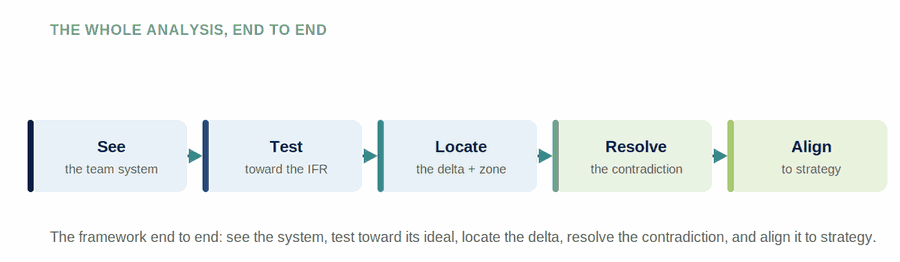
Understanding TSoT and all its nuances does not happen overnight. There are many layers, and each deserves real study and real thought. But taken together, the framework offers a comprehensive way of analyzing team systems and a deep toolset for linking that analysis, objectively, to broader goals and strategies. From seeing a team system clearly, to testing it toward its ideal, to locating the precise delta and the zone it lives in, to resolving the contradiction rather than merely trading it away, to aligning the whole effort with strategy: the framework is one continuous act of disciplined imagination.
The science of teams, in the end, is the conviction that the way people are organized to produce value is not an accident to be endured but a system to be understood, and that with the right tools and the courage to think disruptively, it can always be made better. Take the tools in this book, point them at the systems around you, and do not fear the disruption that follows. Use it to make better teams, and through them, more value in the world.