The ideal team isn't the one with everything added. It's the one with nothing left to remove.
The Science of Teams is a rigorous, testable method for diagnosing why a team underproduces, and finding the single change that improves output without adding cost, headcount, or harm.
TRIZ for the 21st century. The instruments of systematic invention, evolved for team systems and made executable as an ideation compiler ↓
Invention became systematic. Teams are next.
Genrich Altshuller read patents by the hundred thousand and proved that breakthrough solutions are not lightning; they are pattern. TRIZ turned that discovery into a discipline: contradictions named, ideality measured, an Ideal Final Result to steer toward, and a finite catalog of principles that resolve most problems ever recorded. The Science of Teams is that discipline’s next evolution: the same instruments, matured for the most consequential systems there are: teams of people, and now of people and AI together. And where TRIZ has always been practiced by hand, TSoT ships as software.
TRIZ
Altshuller’s discovery, turned into discipline: contradictions, the ideality equation, the Ideal Final Result, and forty inventive principles distilled from the patent record.
The Science of Teams
The instruments matured for the organized effort of people, and of people and AI together: team contradictions, the value and ideality balances, the IFR of a role or an output, 25 solution models, and the Seven Motifs as the test of ideal.
The Ideation Compiler
The method, compiled. Draw the team system, mark your judgments, and the diagnosis, the ideation worksheets, and the boardroom deck are compiled from the diagram, deterministically, with every sentence traceable to the drawing.
Where TRIZ asked its practitioners to master forty principles, the compiler routes the right instruments to the right elements for you. Read the position paper →
Put the method to work today
Software that runs the full Science of Teams analysis on your own team. The Canvas is an ideation compiler: map the system, tag the tensions, and the illustrated report, the ideation worksheets, and the presentation are compiled from the diagram you drew, deterministically, grounded entirely in the published method. The software is one of five ways to put the method to work; see the offerings →
Run the analysis
- Full access to the analysis tool
- Unlimited projects and saved diagrams
- Illustrated deliverable generation
- Every solution model in the method
- Use on up to 2 devices
Read the method
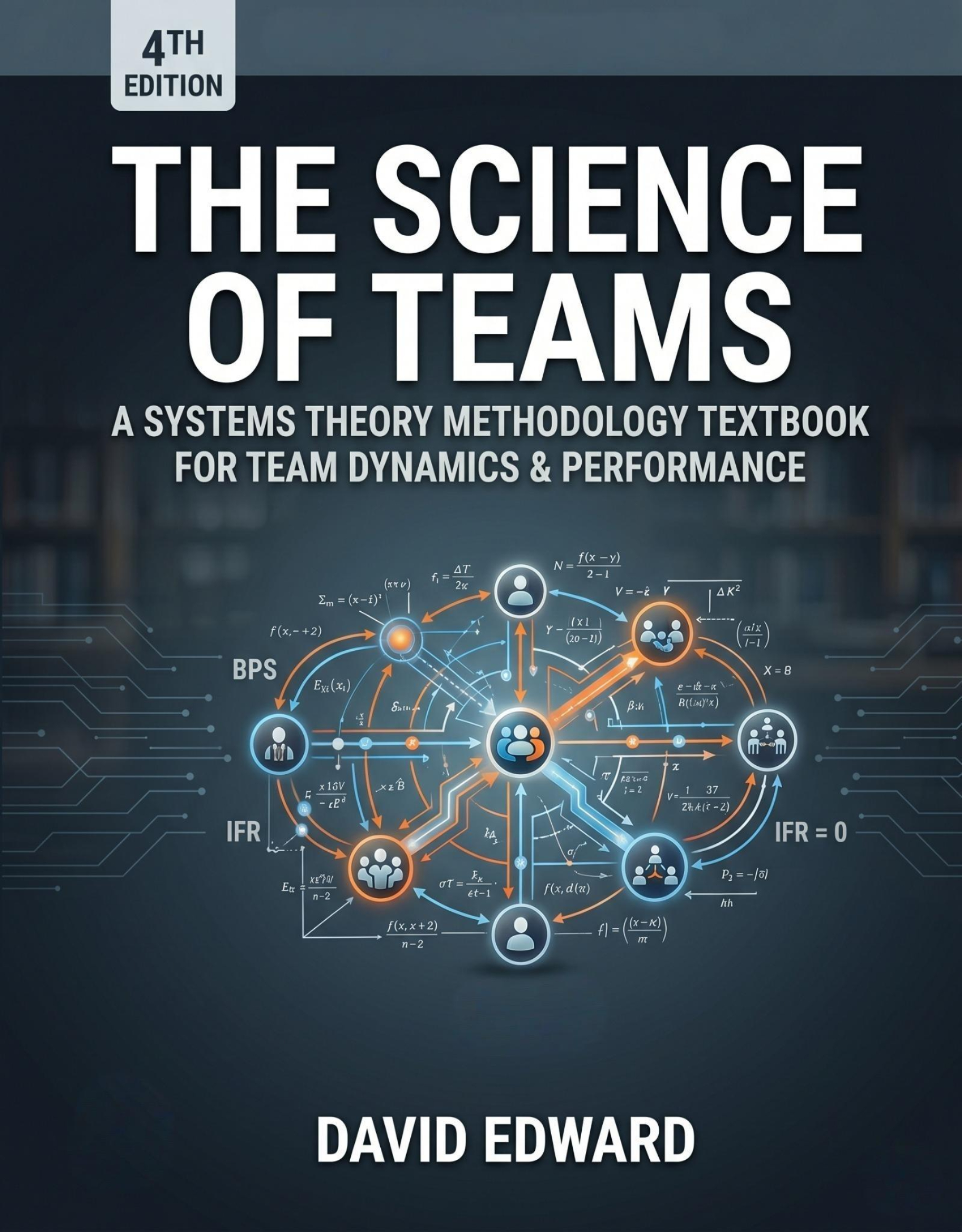
Want to see everything the tool does first? Read the tool guide & FAQ →
Already have a license? Sign in to the tool →
TSoT Tool Demo
A walkthrough of the analysis tool by its creator, David Edward Lady.
Most team frameworks tell you how people should feel. This one tells you what to change.
The shelves are full of emotional-intelligence and culture work, and it has real value. What's missing is the other half: a hard-science instrument that treats a team as a system, measures it objectively, and finds the highest-leverage move. TSoT is built to be that complement.
The soft side, alone
Engagement surveys, personality types, off-sites, motivational coaching. Useful for buy-in and morale, but it rarely tells a leader which single change will move output, or whether a team needs to exist in its current form at all. The conclusion depends on who is in the room.
The hard side, finally
A defined vocabulary, a repeatable algorithm, and measurable tests. Given the same information and goals, two practitioners reach the same conclusion. It surfaces the real contradiction, where improving one thing costs another, and names the precise change that resolves it.
Bring the method to your hardest team
The framework is published and the tool is self-serve, but the fastest results come from working directly with the person who wrote the method.
Engagement
- David works your hardest team with you
- Live analysis built together
- Findings translated into an action plan
- The tool in the hands of its author
- Scoped to your organization
Foundations Day
- The full framework taught in a working session
- Your own teams used as the case material
- Hands-on with the analysis tool
- A shared vocabulary your group keeps
- On-site or remote
One discipline, four working parts
TSoT moves a leader from seeing a team clearly, to measuring it, to acting on it, to keeping that action pointed at the larger goals of the organization. Each part is taught as a usable tool, not a theory to memorize.
A team is a system
People organized to turn inputs into more valuable output. Fix your level of focus (role, system, supersystem) and the same clarity applies to a crew, a department, or a whole company.
Ideality & value, held at once
Output measured honestly against required output, after subtracting the problems and harms it creates, balanced against benefit versus cost. Two questions asked together that keep the analysis from lying to itself.
Find the contradiction
A repeatable sequence that names the one place where improving what you need costs something you must protect, then points to the specific change that resolves it, drawn from a catalog of solution models.
Read where it's headed
Teams emerge, advance, specialize, and either rise into something larger or hand off their value and free their people. Knowing the stage tells you what move the system is actually ready for.
Three tests, applied in order
Before changing how a team works, the algorithm forces three questions in sequence. The biggest gains hide in the first one, which is the easiest to skip.
Can the need go away?
Not "how do we do this faster," but "what would have to be true for this output to be produced with no dedicated effort at all?" When it can, the people aren't cut, they're freed for the next problem.
Do benefits beat cost?
If not, name the delta precisely: raise the benefit, lower the cost, or both. The test doesn't tell you how yet. It tells you exactly which quantity must move, and in which direction.
Does output meet need?
Actual output against required output, counting honestly any new problems a fix introduces. A change that hits the number by creating fresh harm hasn't passed. The algorithm keeps those harms in view.
The entire framework, published in full
The complete Science of Teams is freely readable here, chapter by chapter, with every diagram. Reading it teaches the ideas; the training installs the capability. Both matter, and they're different things.
The Core
What a team system is, output that has value, and the principle of ideality.
The TSoT Framework
Positive innovation, value conflict, the value chain, contradiction, and the fluid role-system-supersystem hierarchy.
The Team Solution Algorithm
The Ideal Final Result, the Best Possible Solution, and the three tests that find the delta.
Patterns of Evolution
Alpha, Epsilon, Tau, and Omega: how team systems emerge, advance, transform, and transition.
The Seven Motifs & the Ideal
The qualitative content of the IFR, and the full solution-analysis method with worked examples.
Run the analysis yourself
The framework, made operational. Diagram your team as a working system, tag where value is created, lost, or blocked, and the tool names the applicable solution models and shows you where the highest-leverage change is likely to be, grounded entirely in the published method, in your own words, on your own canvas.
Map the system
Lay out roles, systems, subsystems, and the value that flows between them on a working canvas, the same structures the framework describes.
Tag the tensions
Mark contradictions, costs, harms, needs, and the Ideal Final Result. The tool reads the structure you built, never inventing facts about your business.
Get the analysis
It names the solution models that structurally apply, locates them against your own labels, and generates an illustrated deliverable you can bring to your team.
David Edward Lady, DBA

Author of The Science of Teams and a forty-year operating executive. A scientific method delivered by an operator who has carried the P&L, not a theorist describing one from the outside.
Across forty years, David has led technology and operations at the scale where teams either produce or quietly fail. As VP & CTO of a Marriott International SBU he ran distributed multinational teams and moved the numbers that matter. As President of Aspen University he turned a struggling institution into a growing one. As founder and CEO of GeoSpace Labs he built a company from concept to exit.
That operating record is the point: The Science of Teams is a method written by someone who has carried the P&L, not a theorist describing it from the outside, and he has taught organizations such as NATO, the UN, Lockheed Martin, and Boeing.
Bring the hard science to your hardest team.
If you lead an operation where a team isn't producing what it should, and you're tired of frameworks that stop at how people feel, let's talk through what a Foundations Day would look like for your group.